


About us
Davlat Toshev
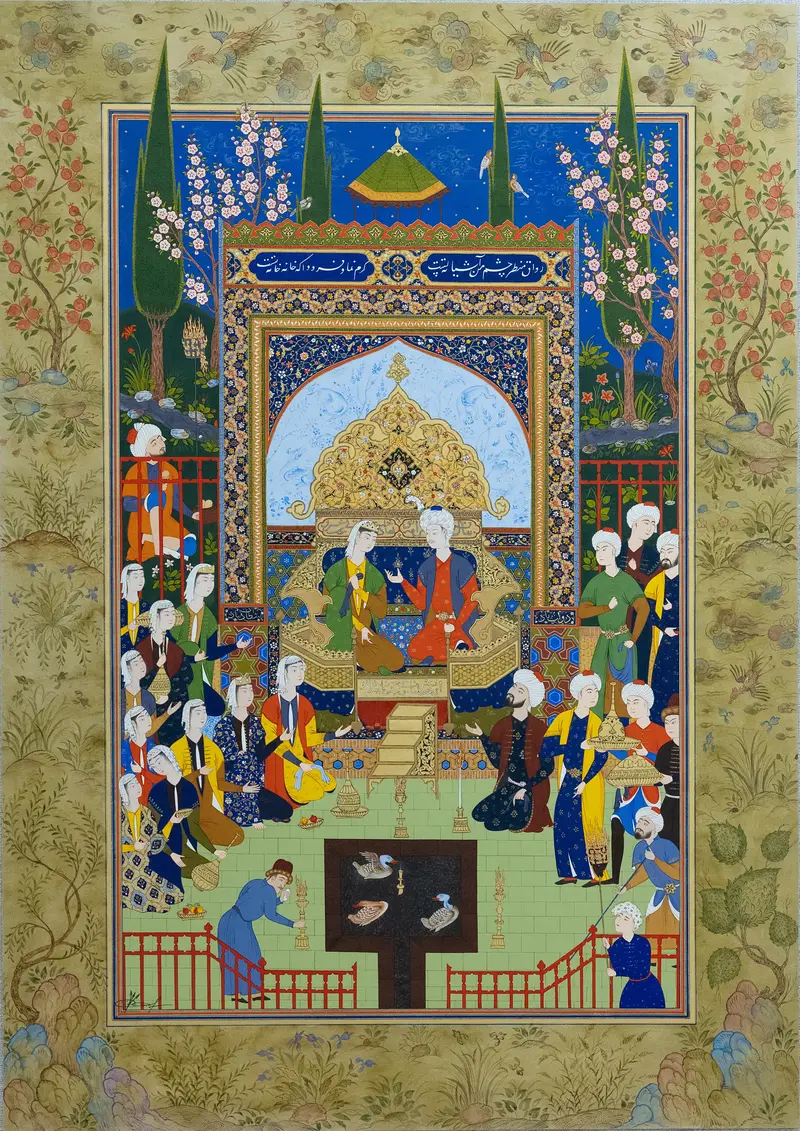
When a master miniaturist came into possession of an old, half-ruined caravanserai in the very heart of Bukhara, many advised him to open a hotel or a restaurant there. But the master had a different calling. Against every pragmatic expectation, he devoted years to restoring the ancient walls in order to create a living art workshop and a free school for gifted children. Where others looked for material gain, Davlat Toshev laid the foundation for preserving the cultural heritage of Bukhara.


Miniatures
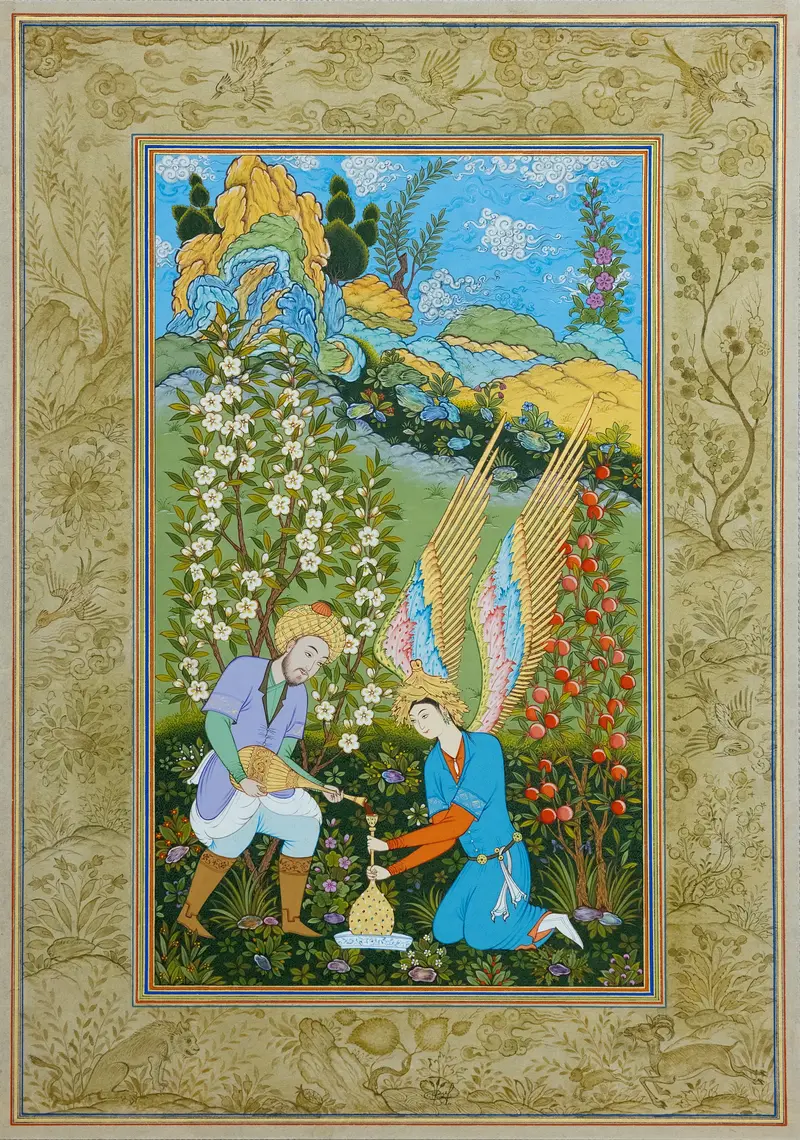
Angel (Maiden)
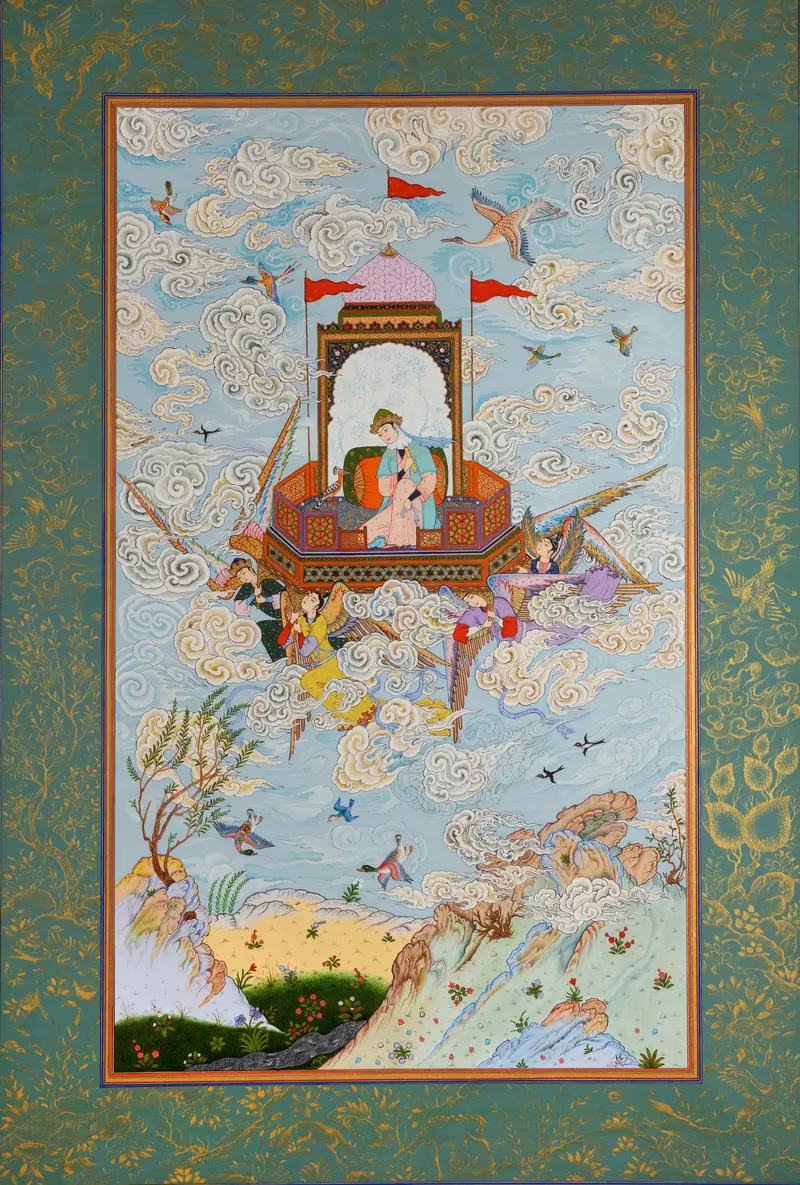
In a garden where one young tree stands in white blossom and another bends beneath the weight of ripe pomegranates, two figures have met. A youth in a lilac caftan leans forward and, with both hands, tilts his vessel — pouring in a thin stream downward, into the golden vessel held by a winged maiden. It is not she who fills it — he gives her all that he carries. Herein lies the essence. The Sufi calls this self-emptying: to receive the highest, the heart must pour itself out to the very bottom, letting go of its own 'I'. The youth does not keep the wine for himself — and the wine here is that very wine of which Hafiz sang, the intoxication of love that inebriates without drunkenness — he pours it out toward the heavenly, and what is given is not lost but received from above. The maiden's wings blaze with gold, blue, and scarlet; the radiant crown above her face tells whence the light proceeds. She does not take by force — she has knelt and merely holds out the vessel, for the gift ascends only by the good will of the giver. The two trees behind them are like an arch of the path: the white blossom of a pure beginning and the ripened pomegranate at its end. The pomegranate, fruit of the paradise gardens of the Quran, conceals beneath its rind a multitude of seeds within a single skin — an image of the fullness that comes to replace emptiness: the youth pours himself out dry, while beside him ripens a fruit filled to the brim with seeds. This scene took the master ninety days of painting with a brush finer than a hair. About the work The work is executed in the spirit of Bukhara book miniature of the 16th–17th centuries — the art of Maverannahr, which absorbed the refinement of the Herat circle with its love of the flowering garden and the slender figure. The scene of wine-drinking and cup-bearing is one of the most enduring images of the Persian–Central Asian tradition, where the cup and the wine long ago ceased to be literal and became a language of mystical love. The winged giver-figure points to a broad body of depictions of heavenly messengers in Eastern painting. The fine rendering of foliage and flowers, the gilded rocks and stylized clouds, the richly ornamented field with figures of animals along its edges are characteristic marks of this circle. The background does not reproduce any particular locality but creates an image of an ideal garden. Details Base: Natural handmade Bukhara silk paper (90% silk, 10% cotton) Technique: Tempera, watercolour, natural plant and mineral pigments, gold leaf (23 carat) Unique piece
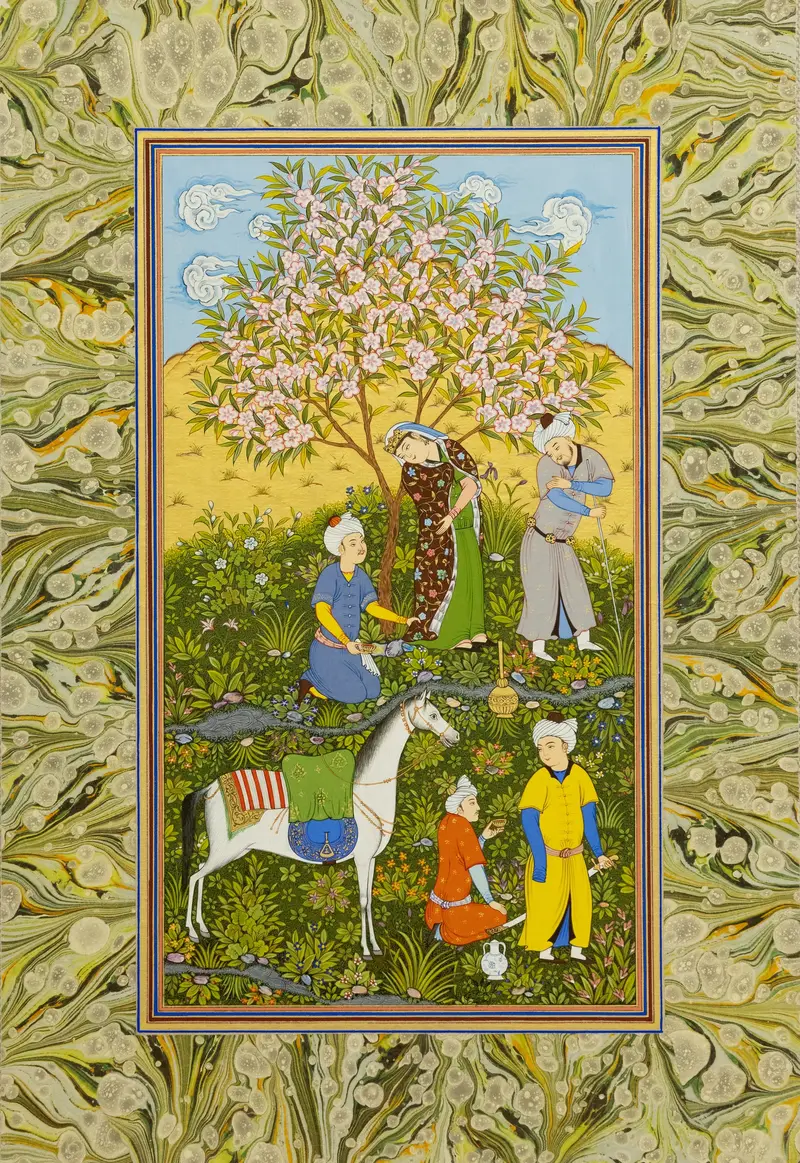
The Spring of Love
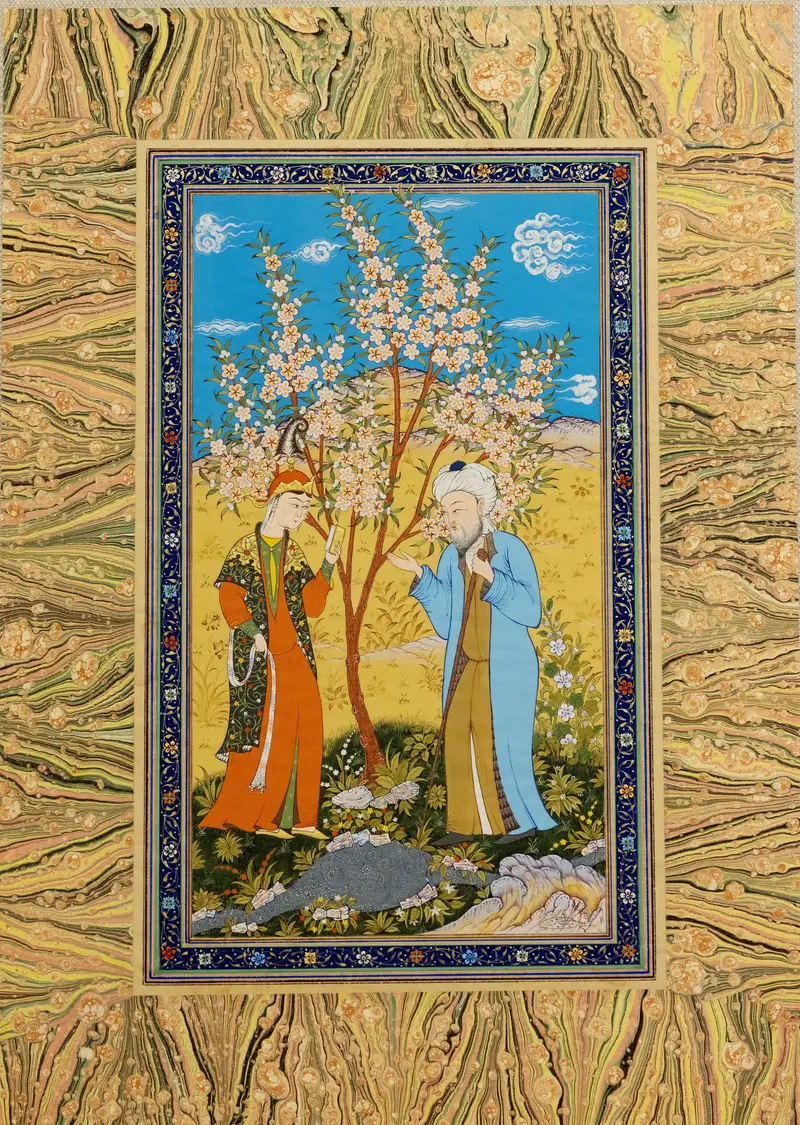
Beneath a flowering tree, close to the trunk, stands a maiden in a dark patterned dress over a green one, a light veil falling from her head. She is that Beauty around which all else has grown still. On the left a youth in blue has sunk to one knee. In one hand he holds a cup filled to the brim; with the other he barely touches the hem of her dress — not daring to embrace her, not daring to speak, only to hold the hem so that she will not go. In this cautious touch of the cloth is all of love at once: both the humility of one who asks for nothing more, and the boldness of one who has nonetheless dared to touch. And the cup in his hand is filled level with the brim and about to overflow — like a heart that can no longer hold what it carries. On the right stands another — a youth in grey, turned away, his gaze lowered, leaning upon his support. He too loves, but his lot is different: to see Beauty and not draw near. He is the ashiq, the lover from afar, whose love has passed wholly into longing — into that sweet pain which seeks no answer and lives by contemplation alone. Thus in a single garden two measures of feeling have met: the hand that holds the hem, and the eyes that do not dare to lift. Below, beyond a narrow ribbon of water, another life goes on in its own course: a white horse under a green caparison, a youth with a blade at his belt, a third offering a cup. They are about their own business and do not raise their eyes to the tree — as though the spring of love were poured out only there, above, while here an ordinary day flows on. This scene took the master five months of work with a brush of a single hair. And above them all the tree has opened into blossom — a white-and-pink cloud upon the green of the foliage. It explains nothing and points to nothing; it simply blooms above the lovers, as every spring blooms above those who love — briefly and with all its might. About the work The leaf belongs to the tradition of Bukhara book miniature of the sixteenth and seventeenth centuries, heir to the courtly art of Maverannahr with its gilded and azure grounds, its finely drawn flowering garden and its cloud-bands in the Far Eastern taste. The scene of love in a garden is one of the enduring motifs of Persian-Central Asian painting, in which earthly feeling is read as a stage toward, and an image of, a higher love: ishq majazi leading to ishq haqiqi. The composition, divided by the flow of water into two planes, follows the long-standing tradition of a multi-tiered construction, in which the near, everyday world is set against the world of the heart's contemplation. Here the language of flowers, poses and gestures matters more than the story: each figure is a shade of one great feeling. Details Base: Natural handmade Bukhara silk paper (90% silk, 10% cotton) Technique: Tempera, watercolour, natural plant and mineral pigments, gold leaf (23 carat) Unique piece
The Dance of Spring
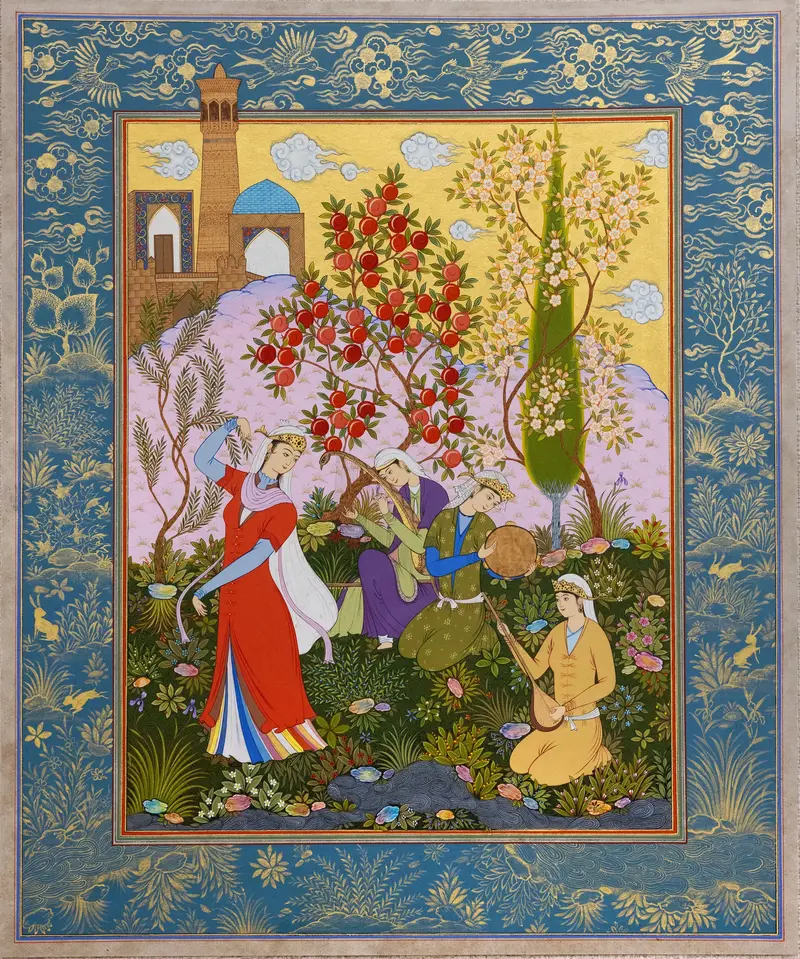
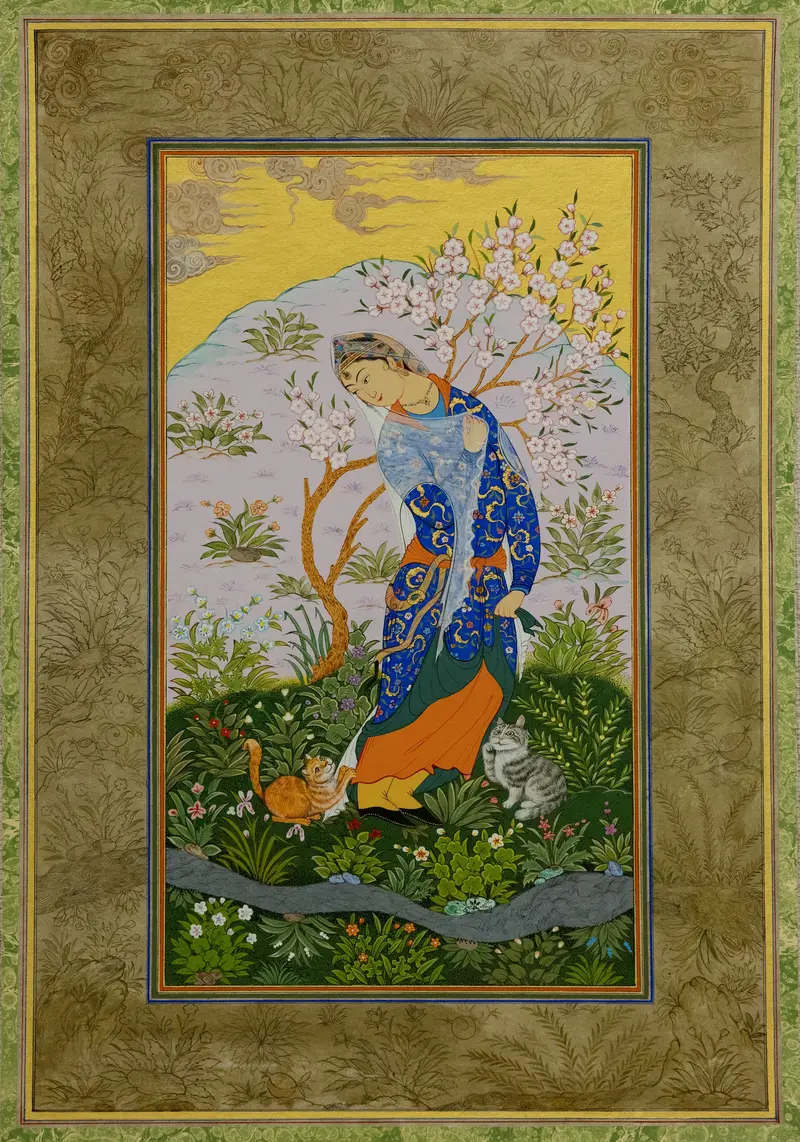
In the East, spring is not merely a season. It is the moment when the world remembers itself. Before you is a garden at the hour of its highest triumph. A pomegranate tree in full fruit, a white flowering tree beside it — almost weightless, like a cloud that has settled upon the earth — and a cypress, reaching upward, stern and silent. And in the background, a minaret, a Bukhara one, recognizable. The artist places his characters not in an abstract paradise but in a specific place — Central Asia, a city, a history. In this garden there are four figures. A dancer in scarlet — she is not performing, she is answering. Answering the music of the dutar, the beat of the doira, the very movement of spring around her. Two musicians are immersed in the sound the way one is immersed in prayer. The fourth figure, a little apart, watches — and in this watching too there is participation. In the classical Persian and Turkic poetry that the Bukhara masters illustrated, the spring garden is always a twofold image. The outer one — flowers, music, youth. And the inner one — the soul, awakening from its slumber, discovering within itself the capacity for joy. This is precisely why no one here looks at one another — everyone looks inward or upward. The border is executed in the technique of gold tooling on a deep blue field: flying cranes, hares in the grass, fantastical birds — this whole world frames the main subject like a living boundary between the ordinary and the sacred. About the work The work is created in the tradition of the Bukhara miniature of the 16th–17th centuries, when the workshops of Bukhara under the Shaybanids illustrated the poetic manuscripts of Navoi, Jami, Nizami. Every detail — from the folds of the garments to the veins on the leaves — is executed by hand with the finest brush. The golden sky in the upper part of the picture is not merely a background: in the tradition of the Eastern miniature, gold signifies a space beyond time. Details Base: Natural handmade Bukhara silk paper (90% silk, 10% cotton) Technique: Tempera, watercolour, natural plant and mineral pigments, gold leaf (23 carat) An exclusive original work, possessing high artistic and investment value. Price and terms of acquisition are provided upon individual request.
The School of Wisdom
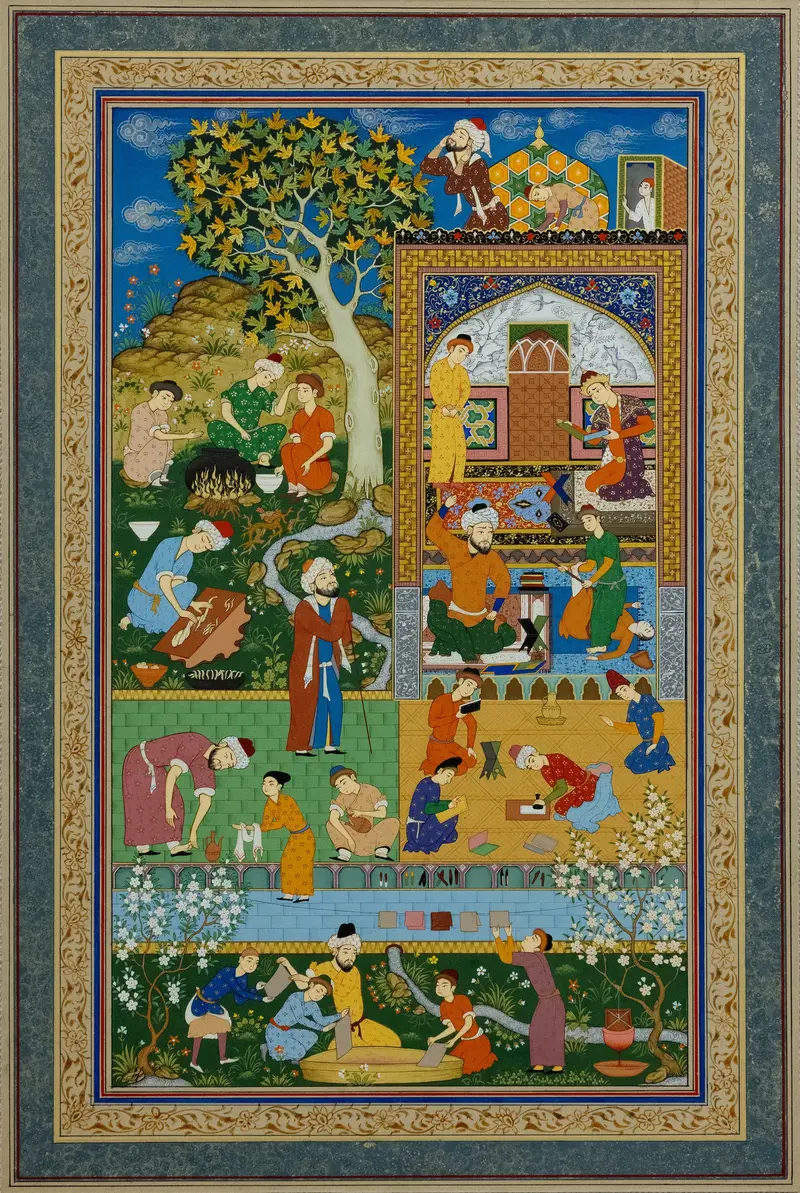
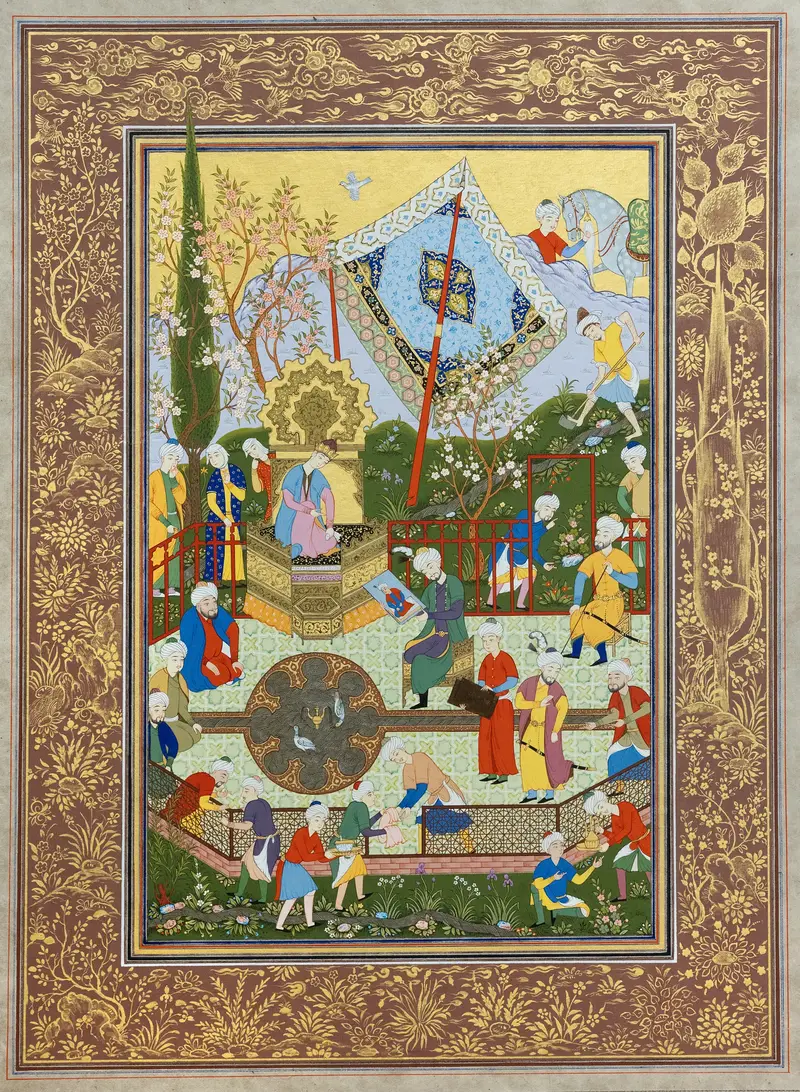
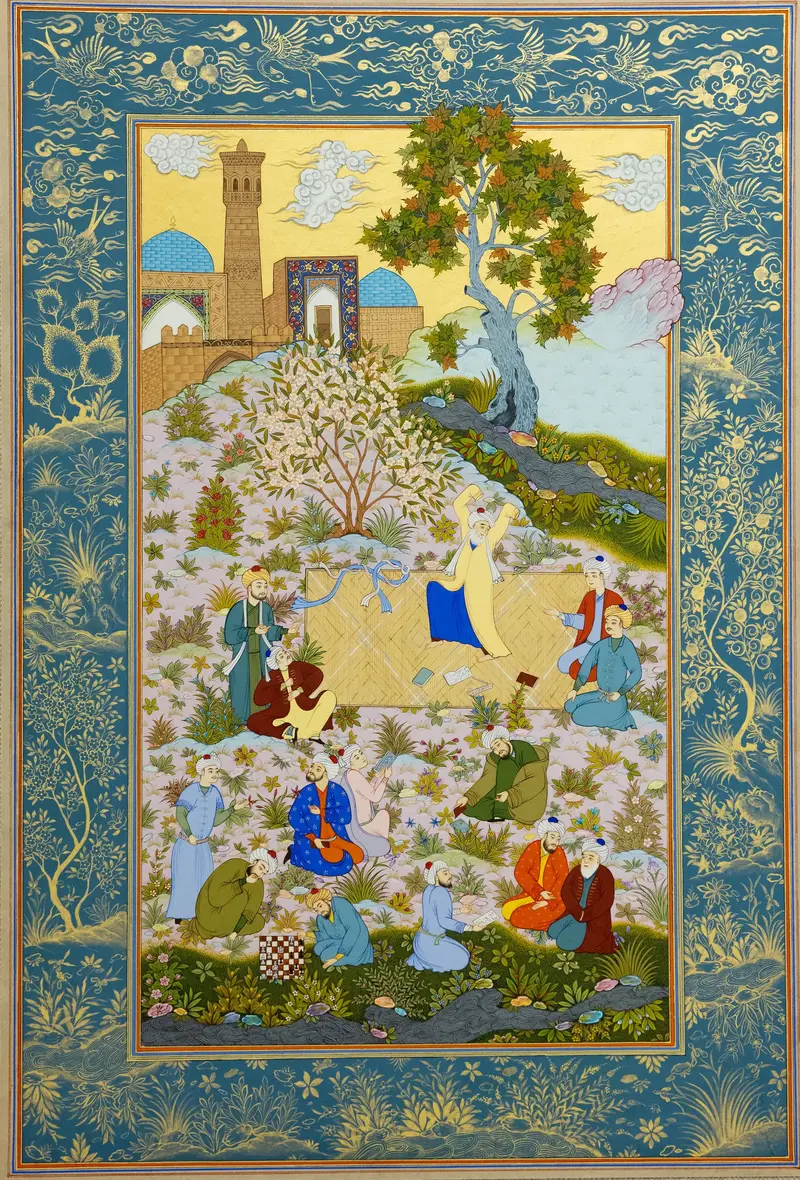
The miniature is read from bottom to top — like an ascent up steps, where each tier stands higher than the last, in body and in spirit. At the very water's edge, below, hands are busy with a coarse and pure labour: here Bukhara paper is made — the sheets are soaked, pressed out in a round vat, and hung up to dry. Nearby, figures bow in ablution, and the clay jug at their feet, the fresh cloth in the attendant's hands, speak of the same care — to set the outward in order. This is the threshold of every path: law and purity, the preparing of raw material. As a cloudy fibre, through water and labour, becomes a sheet ready to receive the word, so a man begins with the cleansing of that which is without. A tier higher, labour of another kind is in full swing. In the maktab a stern mentor with a rod governs his pupils: one is diligently bent over a book, another is being chastened for negligence. In the courtyard texts are copied, reed pens are mended, ink is ground. And to the left, by the fire and the cauldron, dough is kneaded, water is carried, firewood is split — the abode feeds itself, and daily bread is baked beside the bread of knowledge. The figure with a staff at the centre binds these scenes together, as a shepherd binds his flock: this is the level of the path under guidance, where obedience and daily effort gradually tame the wilful 'self'. Higher still, by the tiled dome, two figures are already withdrawn from the bustle: one has grown still, cheek propped on his hand, in thought, the other stands on the threshold of an opening. This is the silence of knowing with the heart — the contemplation that seeks no more books. And at the very summit a man has raised his palms to his ears. The adhan passing into the takbir: the call that wakes the soul from sleep, and at the same time the entry into standing before God, when the whole world is cast behind one's back. Having passed through water, labour, study and submission, the soul at last hears the single Sound — and the seething of the cauldron, the thud of the axe, the rustle of the sheets below fall silent for its sake. Ten months went into this work. About the work The work continues the tradition of the Bukhara miniature of the sixteenth and seventeenth centuries with its heritage of the Herat circle: a multi-tiered composition in which several scenes live on a single sheet, a dense colouring and the finest delineation of figures, grasses and tiles. The subject of the life of the maktab — an abode where one teaches, labours and prays — allows the whole sheet to be read as an allegory of the ascent up the steps of the Sufi path: from outward purification and law, through the discipline of apprenticeship and knowing with the heart, to direct standing before the Truth. Such an allegory is close to the spirit of the didactic poetry of Maverannahr, in which craft and everyday labour invariably turned into an image of inner work. The scene of papermaking is a rare and precious detail: the craft for which Bukhara was famed is shown here not in full, but recognizably, as the foundation of all written knowledge. Details Base: Natural handmade Bukhara silk paper (90% silk, 10% cotton) Technique: Tempera, watercolour, natural plant and mineral pigments, gold leaf (23 carat) Unique piece
The Onager Hunt
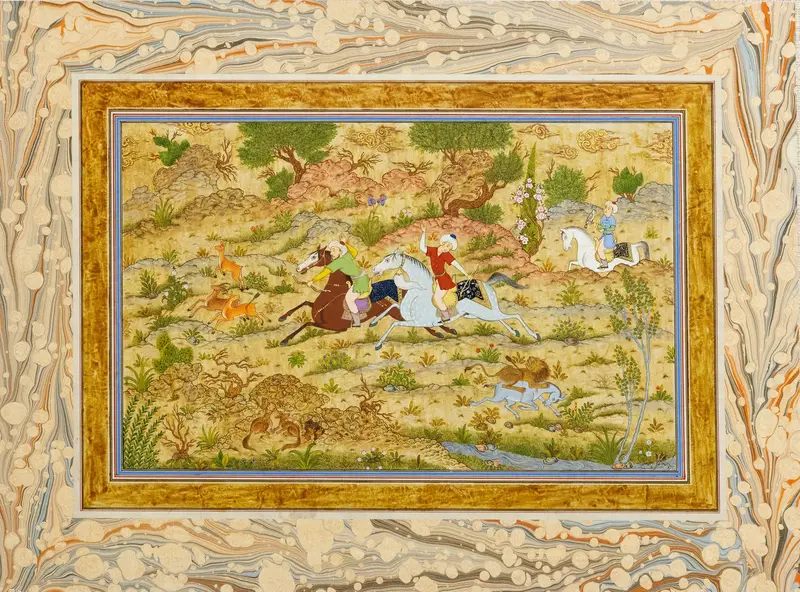
Across golden hills, where the cliffs shimmer with rose and the gold of the clouds curls in the Chinese manner, three horsemen ride. The one on the left, in a green kaftan, has already drawn his arm back — the bowstring has sung, and his arrow has overtaken its quarry at the far edge. But everything in this sheet is drawn toward a single gesture: the king in red has risen in the saddle of his dapple-grey horse and flung his hand up to the sky. He has just done the impossible. Below on the right a lion has fallen upon a wild onager, sinking its claws into the grey back — and in that same instant a single arrow has passed through them both, pinning predator and prey to the ground. Thus legend fixed upon Bahram Gur the fame of the greatest of archers. But the hand is not raised for the sake of marksmanship. The lion here is force that revels in itself and torments the defenceless; the onager is the one who has no protection but the king's justice. The first law of power is not war but judgement: to punish oppression at the very moment one sees it. And there is in this blow a second, quiet truth — the triumph of force is itself the hour of its reckoning; the eye that keeps watch over every sleeping self-assurance never closes. The third horseman keeps to one side, and on his hand a hunting bird sits calmly — a trained soul that knows its master's wrist and returns at his call. To the right stands a slender cypress — an image of the abiding: a stillness not drawn into the chase, a witness untouched by either hunter or quarry. At ground level a brook winds along, an indifferent line toward which both hunter and game flow down. And in a burrow in the foreground foxes guard their cubs — life goes on in its own quiet course, knowing nothing of the lion or the arrow. This scene cost the master eight months of work with a brush of a single hair. And yet a single arrow passed through the two: to cut away vice, the point passes through living flesh as well. About the work The scene belongs to the tradition of the courtly hunting miniature of Maverannahr as the Bukhara school of the 16th–17th centuries knew it, with its love of the golden ground, the fine-grained working of grasses and beasts, and cloud bands in the Far Eastern spirit. The subject harks back to the legend of Bahram Gur — a Sasanian sovereign who entered Persian poetic memory not so much as a warrior as a model of the just king and the peerless hunter. The motif of a single arrow piercing lion and onager is one of the most recognizable in the pictorial tradition tied to this hero. Here it is presented not as a trophy but as a parable of power, judgement, and the inevitability of reckoning. Details Base: Natural handmade Bukhara silk paper (90% silk, 10% cotton) Technique: Tempera, watercolour, natural plant and mineral pigments, gold leaf (23 carat) Unique piece
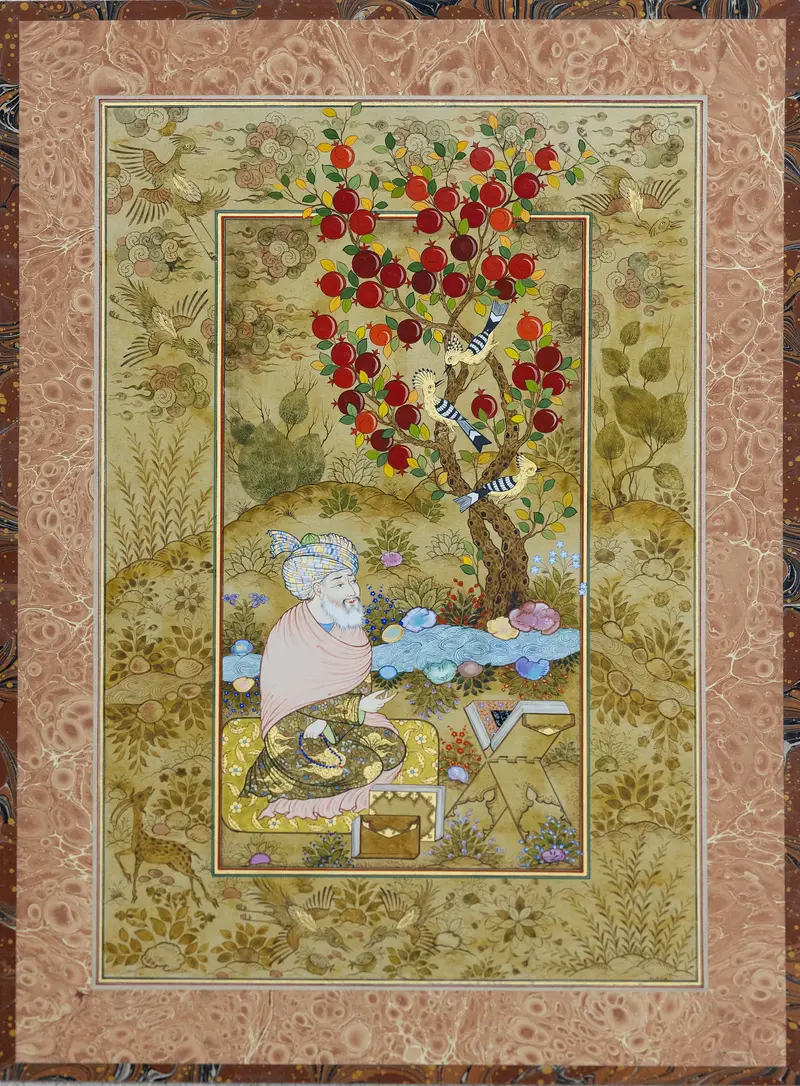
Rumi
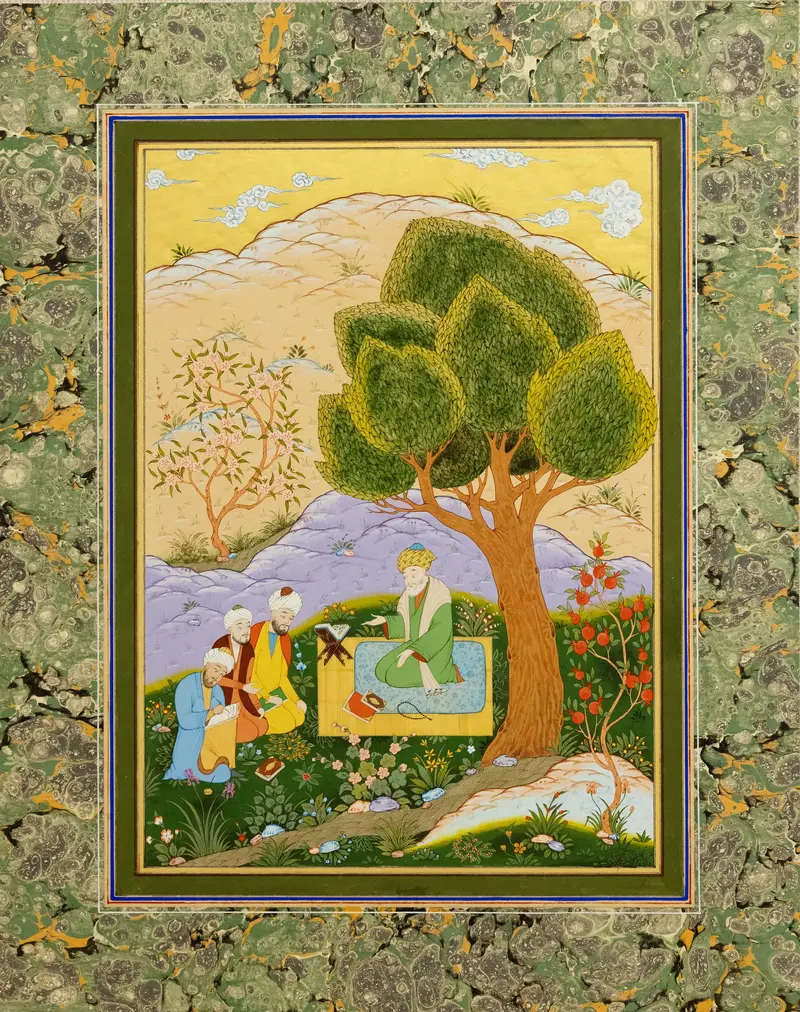
"Through love the bitter shall be transformed into the sweetest, Through love copper shall be reborn into the purest gold." At the very edge of the water, on a golden mat, sits a grey-bearded elder in a tall turban — Jalaladdin Rumi. Prayer beads slip through his fingers, his gaze turned into the distance, beyond the garden, to where words are no longer needed. Before him, open on a carved stand, lies a book — 'Masnavi', his own ocean of verse — and beside it rest a writing set and a case for scrolls. But he neither reads nor writes: he abides. This is not a garden where one has come to learn — it is the garden of one who has already arrived. Above him rises a pomegranate tree, heavy with ripe fruit. Here the pomegranate is neither a promise nor the abundance of the table, but a ripened heart: that which no longer reaches for the fruit, for it has itself become the fruit, filled to the brim. On the branches three hoopoes sit motionless. They are not disciples — they are friends of God, fellow seekers, whose very coming is itself a testimony: where the friends of God have gathered, His presence too is near. Their silence beside the sheikh is the conversation of equals. To the left, by the bushes, stands a gazelle — and it does not flee. For one still on the road, the gazelle is the elusive Truth, forever beyond the next hill. But before Rumi she has grown still, tame and near: the Truth that has ceased to slip away, that has stayed with the one who has nowhere left to go. She is near not as prey, but as a friend. And right at the water's edge lie stones — red, green, blue, white. Whoever has read the tale of Mushkil Gusha, the resolver of difficulties, will recognise them at once: that scattering of gems revealed to the one who has climbed the stairway. Each colour here is a light of its own, its own prophetic road, sent to people in its appointed hour; green bears the light of Muhammad ﷺ, and beside it lie stones of other colours — the other paths of the great messengers. Different in colour, they lie together by the one water, for they lead to the One. Here is the quiet cipher of this garden: the roads are many — the Source is one. This work took the master 100 days, with a brush of a single hair. About the work The leaf belongs to the tradition of Bukhara book miniature, heir to the mastery of Maverannahr of the 16th–17th centuries: a gilded ground, the fine working of foliage and flowering grasses, cloud-bands in the Far Eastern taste, the calligraphic lightness of line. The composition is built around the figure of a Sufi poet in a garden — an enduring motif of Persian and Central Asian painting, where nature becomes a mirror of the inner state. The images of the birds, the beast and the fruit-bearing tree are here no everyday backdrop, but the language in which Sufi poetry speaks. The scene unites the portrait of a sage with the parable-like depth characteristic of illustrations to Sufi texts. Details Base: Natural handmade Bukhara silk paper (90% silk, 10% cotton) Technique: Tempera, watercolour, natural plant and mineral pigments, gold leaf (23 carat) Unique piece
“Ustoz Shogird” school
In 2019, in the very heart of ancient Bukhara, master Davlat Toshev founded the “Ustoz-shogird” (“Master and Apprentice”) Centre of Traditional Applied Arts — not merely a studio, but a living space where the ancient craft of the Eastern miniature is passed on from heart to heart, from hand to hand.
MINIATURES ON SALE
 @ustoz_shogird
Thank you
Your request has been sent, our staff will contact us shortly