

The Festivity
Home / Miniatures / The Festivity




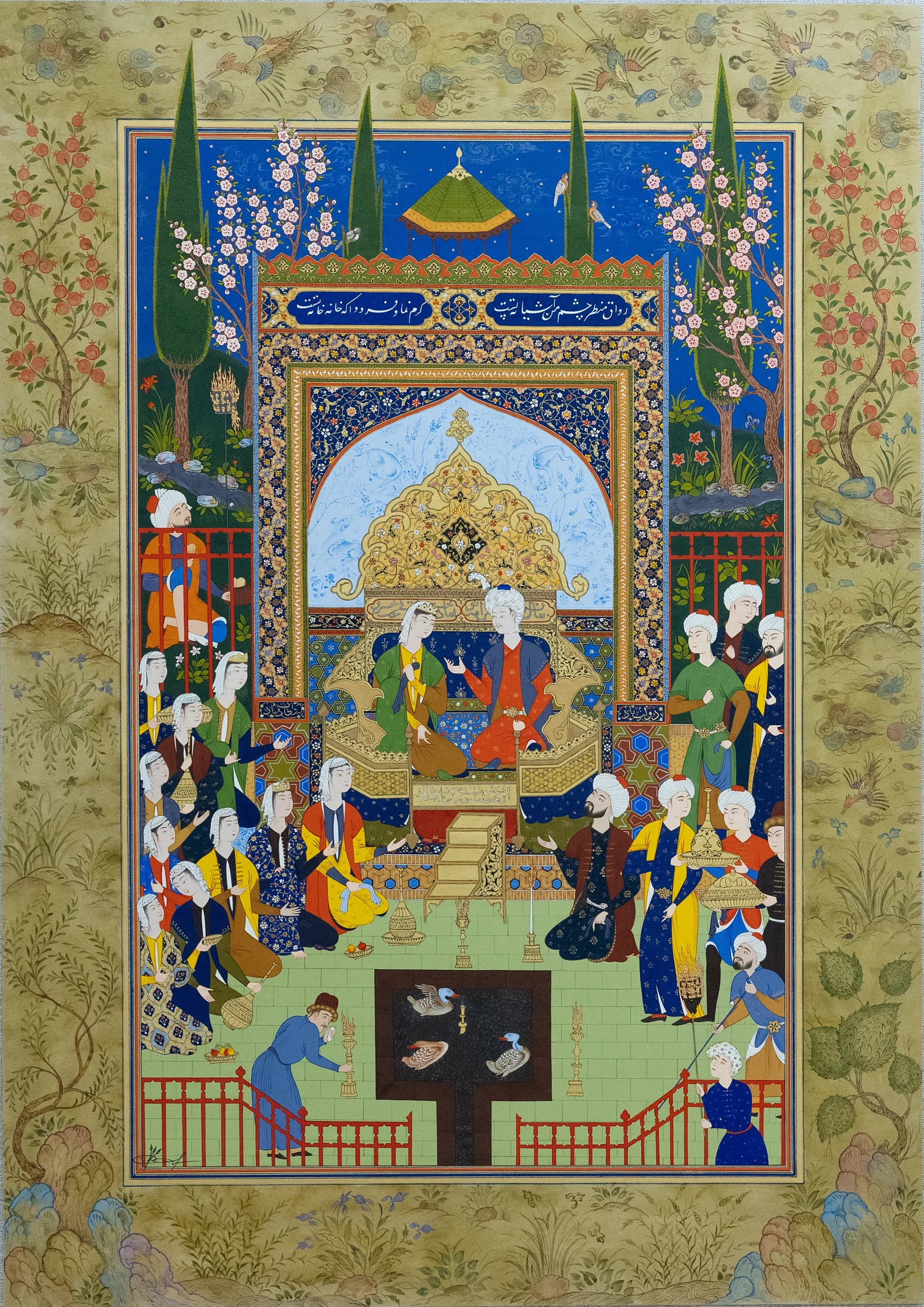
Image size:54 × 75 cm
On a golden throne, framed by a carved arch in the form of a flowering nimbus, two figures are enthroned — a young maiden in green and gold and a man in scarlet and blue, turned half toward her: his palm raised and open, as though he were putting into this gesture not a thing but a word — and the whole night around them is arranged for the sake of this single moment. Above the arch is the tracery of an inscription, a witness that here verses were read and not only feasting done. On the left are women musicians with oud and tar, a tightly closed circle where glances and gestures flow toward one another without words. On the right servants carry covered dishes, someone holds a lamp: a movement of offering, answering the movement of the music. At the foot of the throne are three fruits on dishes: an apple, a pear, a pomegranate — a garden offered in condensed form. In the centre of the courtyard is a candle on the right, a vessel on the left, and between them a censer: the thin thread of smoke here is not merely incense but a sign of the unseen bond between those who are here and that which is higher than the sky — a reminder that even the most splendid feast lasts no longer than this smoke curls upward. By a pool with ducks, behind a red railing, servants kindle fires: water and flame side by side, like two different ways of remembering the transient. The night sky above the dome is deep, blue, with birds, as though the very architecture were being drawn upward. On this scene — with dozens of faces, each of which had to be lived through separately by the brush — the master laid down six months of labour. About the work The composition belongs to a type of courtly celebration widespread in Perso-Central Asian miniature, where a pair on a throne beneath a carved arch is surrounded by musicians, servants, and a garden — an enduring iconographic formula often used for scenes of betrothal, accession to the throne, or the meeting of two noble personages. Such scenes were especially popular in Bukhara and Herat book painting of the 16th–17th centuries, not infrequently illustrating episodes from classical poems about rulers in love. The court, brought out into a garden with flowering trees and a body of water, reads here not as a background but as a continuation of the celebration itself — nature rejoices together with the people. The censer at the centre of the courtyard is a detail characteristic precisely of reception and feast scenes in this tradition, where incense accompanied both hospitality and prayer. Details Base: Natural handmade Bukhara silk paper (90% silk, 10% cotton) Technique: Tempera, watercolour, natural plant and mineral pigments, gold leaf (23 carat) Unique piece


Similar products

Thank you
Your request has been sent, our staff will contact us shortly