

The Legend of Queen Bilqis
Home / Miniatures / The Legend of Queen Bilqis




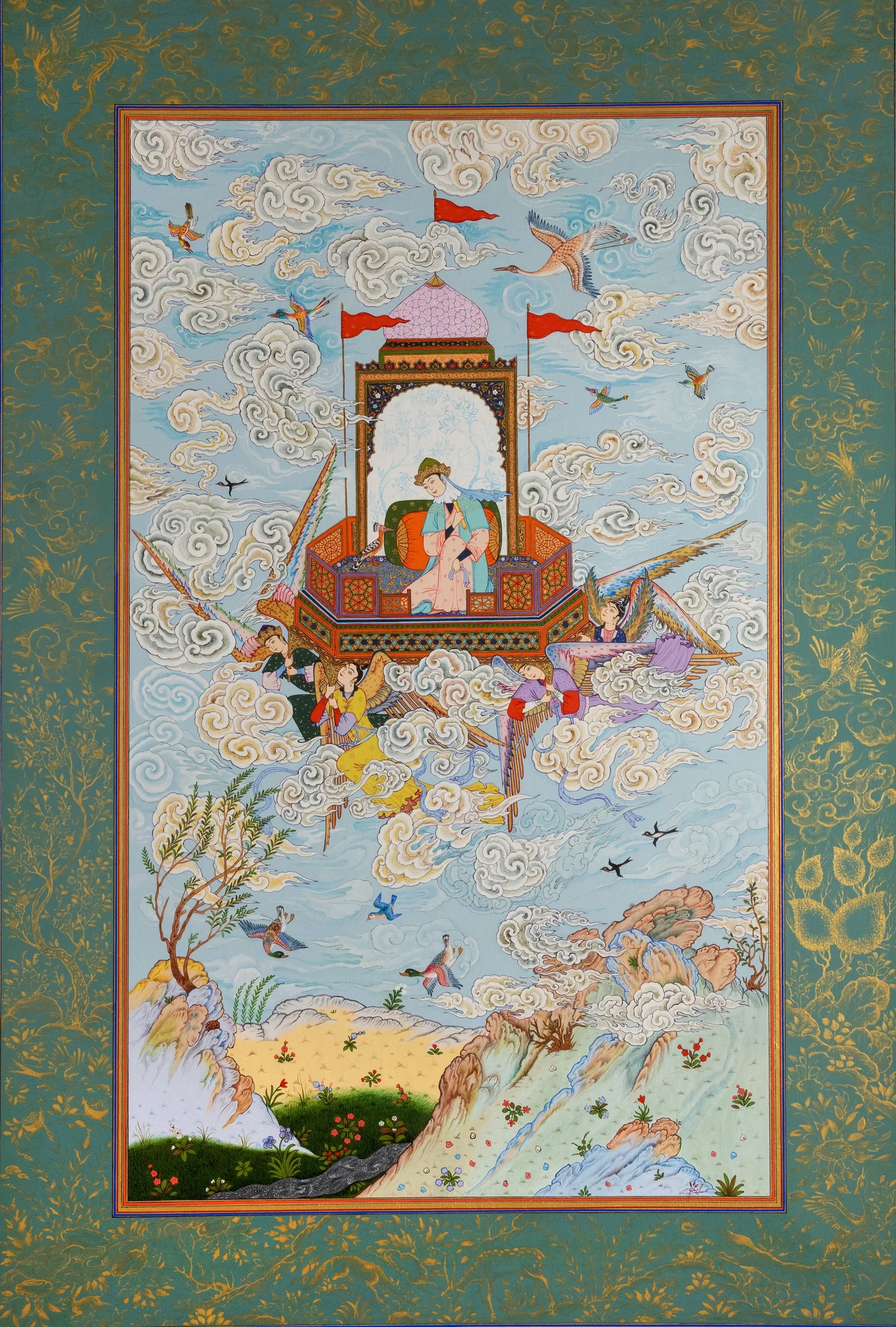
Image size:43 × 63 cm
Between heaven and earth, upon a palanquin-throne with a lilac dome and scarlet banners, Queen Bilqis flies. The earth below — with its cliffs, its brook and its flowering meadow — she has already left behind; the clouds part before her in curling scrolls, like lines of script scattering before the opening of the main one. The throne is borne aloft on the wings of four angels — not servants, but the very lifting force of faith: that which seeks the truth does not walk to it across the earth, it is carried. At her shoulder, on the rim of the palanquin, sits a hoopoe — that very bird which in the legend became the messenger between two kingdoms, the first to learn and the first to tell. Here he is small, almost unnoticed amid the gold and the ornament — like every true tiding, which does not cry aloud. All around fly cranes, ducks, dappled birds — a whole army of the air escorts her whose path is approved from on high. The queen herself is serene: crowned, in a light veil, she holds a scroll in her hand — a sign that this journey began with a word, with a letter, with a summons. The scarlet pennants on their staffs strain forward, toward where the throne moves — the will has already chosen its direction. To this picture of the journey — from the stone below to the dome in the clouds — the master gave a whole year: the span of time in which some other tiding takes just as long to travel from one heart to another. About the work The subject goes back to the legend of the Queen of Sheba — the Bilqis of the Muslim tradition — whose story of meeting the Prophet Sulayman is set out in the Quran, in the surah 'An-Naml'. This story sounds especially detailed and recurrent in Rumi's 'Masnavi', where separate parables are devoted to it — of the khan of the hoopoe, of the flight of her throne to Sulayman, of that one thing she was not willing to give up in turning toward the truth. The flying throne, the angel-bearers and the hoopoe-messenger form the enduring iconography of this legend in the book miniature of Maverannahr and Khorasan of the 16th–17th centuries, where Bilqis's path was read as an image of the soul that has answered the call of the truth. The depiction of a heavenly journey above an earthly landscape is one of the most poetic compositional types of this school: the earth is painted in detail and with love, but the viewer's gaze, like the heroine, no longer belongs to it. Details Time to create: 9 months Base: Natural handmade Bukhara silk paper (90% silk, 10% cotton) Technique: Tempera, watercolour, natural plant and mineral pigments, gold leaf (23 carat) Unique piece


Similar products

Thank you
Your request has been sent, our staff will contact us shortly