

SHAMS. (Jalal)
Home / Miniatures / SHAMS. (Jalal)




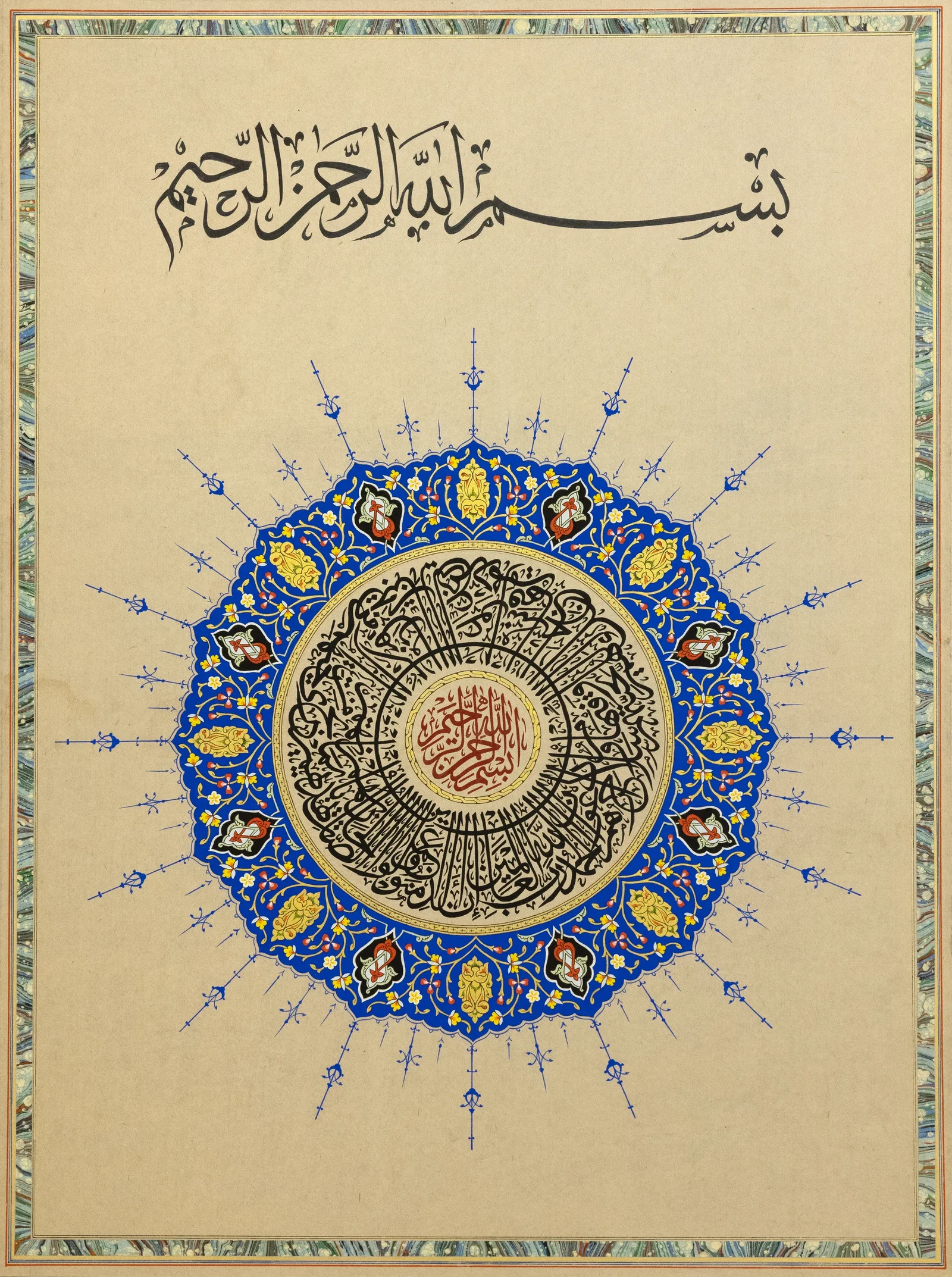
Image size:42 × 57 cm
The sheet opens with the Basmala: above, in a black, soaring and elongated script, are traced the words with which all things begin — 'In the name of Allah, the Most Gracious, the Most Merciful'. Below unfolds the shamsa, the 'sun', but its sky is not of this earth. The field of the medallion is flooded with a deep ultramarine drawn from lapis lazuli: here the blue is no ornament but the very substance of the celestial sphere — the colour of the cosmos and of the divine majesty before which the mind falls silent. In the golden centre is the same Basmala, folded into a circle: the word frames the sheet from above and holds it from within, beginning and core meeting as one. Around the core runs a monumental belt of calligraphy in the thuluth script, the letters woven into the geometry of the circle so that the speech becomes endless, without seam or edge. Across the blue field golden figured motifs pass in waves — a grace that flows gently from the centre, never running dry. And outward, to every end of the sheet, spread fine azure rays with forked tips: the radiance of the celestial height, which pervades space yet does not bring the height nearer to the beholder — it only holds him in awe. Two years went into this sheet for Davlat Toshev, painted with a hair-fine brush; and the lapis lazuli, and the gold, and this very patience serve one end — to point to That which is above every image. About the work The shamsa is a solar medallion with which, in the Islamic manuscript tradition, the ceremonial opening of a manuscript was begun, placing at its core the name of God or a blessing formula. Here we have its 'celestial' version: the dominance of azure points to the most precious pigment of the Eastern miniature — ground lapis lazuli, which for centuries was mined in the mountains of Badakhshan. The composition is strictly centric: the sacred word in the core, a ring of calligraphy in the thuluth script, a blue field with golden ornament, and diverging rays that turn the sheet into the image of a luminary. Such openings demanded of the master months and years of painstaking labour and belong to the summits of the court book culture of Maverannahr and of the whole Perso-Islamic circle. The restrained 'marbled' ebru border along the edge is a characteristic device in the design of such pages. Details Base: Natural handmade Bukhara silk paper (90% silk, 10% cotton) Technique: Tempera, watercolour, natural plant and mineral pigments, gold leaf (23 carat) Unique piece


Similar products

Thank you
Your request has been sent, our staff will contact us shortly