

Contemplation of the Image in the Garden of Truth
Home / Miniatures / Contemplation of the Image in the Garden of Truth




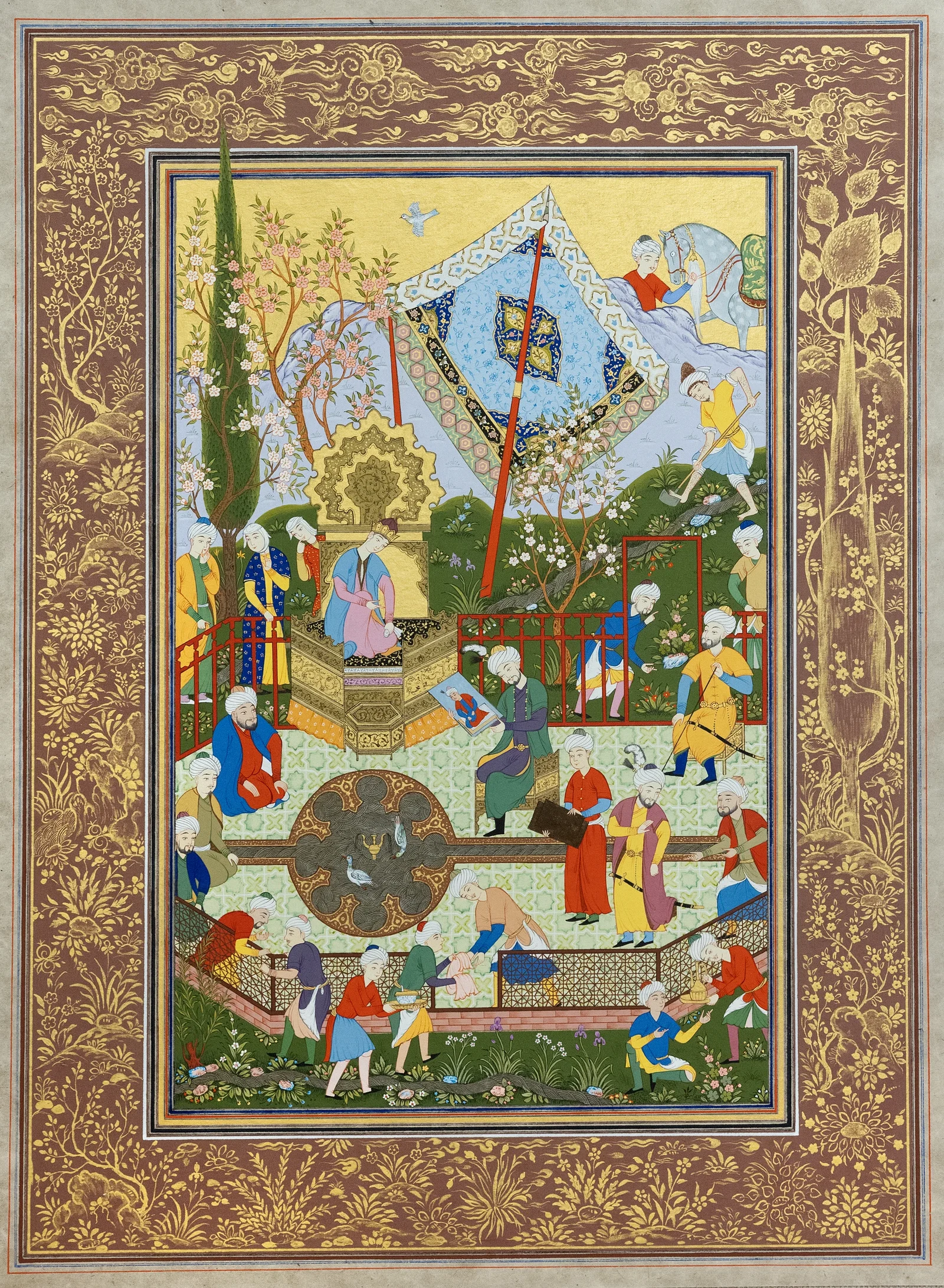
Image size:46,5 × 62 cm
On a dais, beneath a carved gilded backrest that rises above her head like a halo, sits a girl in a rose-and-blue robe, her hands folded before her. Beside her, a little lower, a man in green holds an open sheet bearing the image of a figure in red — and offers it to the gaze of those nearby. So was a portrait once painted before the viewing of a bride: the side courted from afar was known first by paper, not by the face. Here too — an image instead of the living person, the shadow of a meeting to come instead of the meeting itself. And in this lies the Sufi truth of the scene: the visible never gives all. The sheet with the portrait is only a reflection, tajalli in its most modest form, a messenger and not the message itself; the real face is still ahead, beyond the threshold of the garden. And the garden all around is already prepared for that threshold. On the right a servant leads a horse by the bridle — the nafs, the animal soul, subdued and brought under the bridle at the very edge of the sacred place. A little lower a man labours with a mattock over the ground: the cultivation of the heart, mujahada, without which the garden does not bloom of itself. At the centre is a round pool, and upon its dark water rest white birds: water here is the knowledge that quenches, the circle is the sign of perfection without beginning or end, and the birds are souls that have already found their source and hurry nowhere. Over the throne hangs a patterned cloth on a scarlet staff, sheltering rather than adorning — a veil that at once hides the mystery and protects those beneath it. On this whole garden, painted out to the last petal, went a year of labour with a brush finer than a hair. About the work The work belongs to the tradition of the court miniature of Maverannahr of the 16th–17th centuries, where multi-figure garden scenes not infrequently depicted ceremonial and matchmaking episodes of court life. The custom of showing a portrait before a personal meeting is an attested practice of the Eastern courts, which entered both the pictorial and the literary tradition of the region. The multi-tiered composition, with enclosures, a raised throne and domestic scenes along the edges, is typical of the large court miniatures of this circle. The gilded background, the dense ornamentation of the margins and the attention to everyday details are marks of the Bukhara school of painting. The scene is not connected with any particular known subject or historical figure, but conveys a moment recognizable for the age — that of waiting before a decision. Details Base: Natural handmade Bukhara silk paper (90% silk, 10% cotton) Technique: Tempera, watercolour, natural plant and mineral pigments, gold leaf (23 carat) Unique piece


Similar products

Thank you
Your request has been sent, our staff will contact us shortly