

The Trial of Sheikh San'an
Home / Miniatures / The Trial of Sheikh San'an




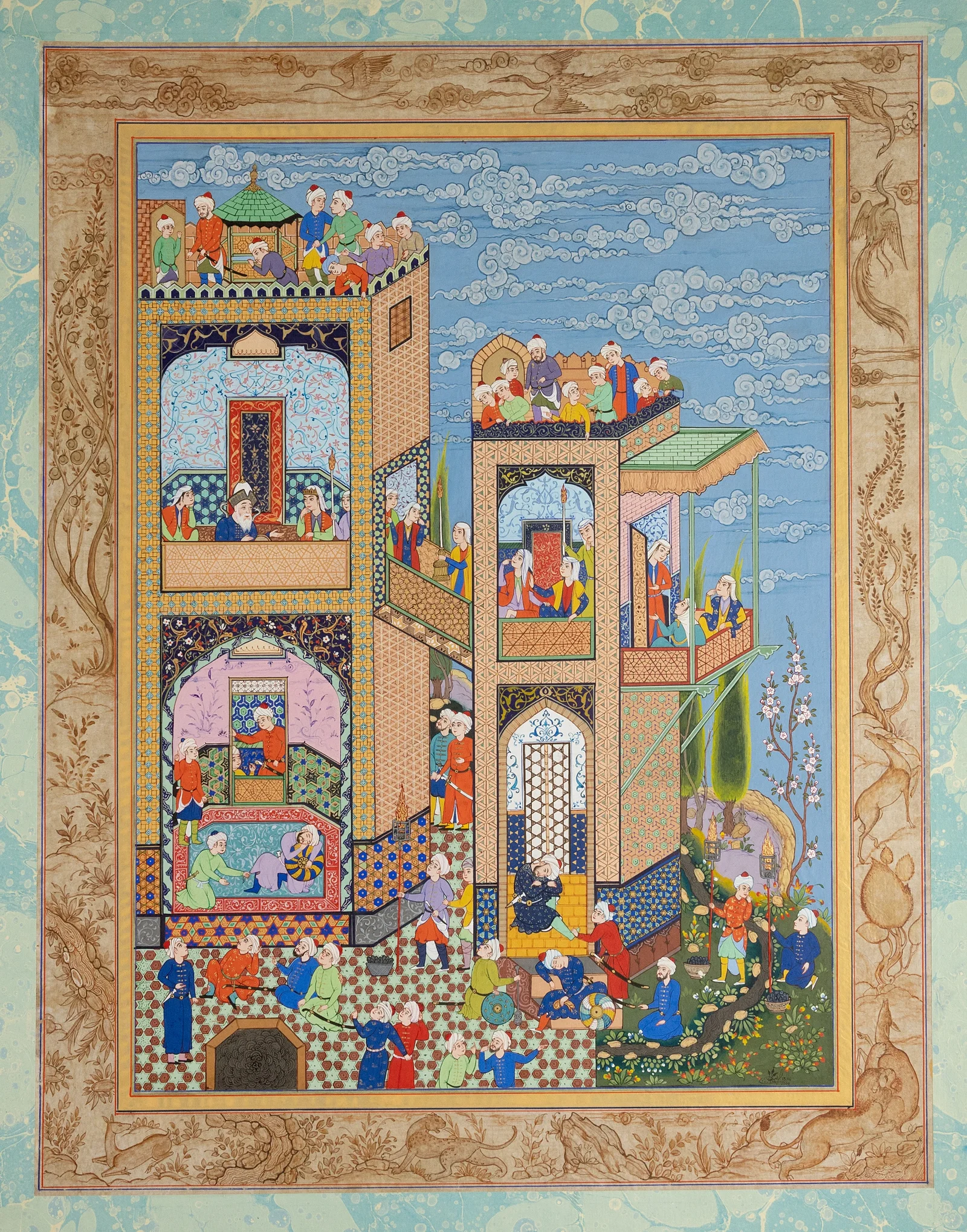
Image size:38 × 54 cm
In this miniature the house itself has become the arena of the trial — it passes through all its tiers at once. On the rooftops and balconies dozens of the sheikh's disciples throng together: one argues, flinging up his hands; another whispers furtively; another stands frozen, unable to believe what he has heard — the trial by rumour, the most merciless of all. Along the middle tier another judgement proceeds: the ruler of Rum in blue robes and, beside him, his daughter, a finger at her lips — the mute sign of utter astonishment at the news of an elder who has lost himself to love. The same princess is shown a second time as well — now alone, on a distant balcony beneath a canopy, gazing down to where not her own fate but another's is being decided, and there is no escaping that gaze. Lower down, in the inner chambers, two disciples keep a fast, forgoing food and sleep — their loyalty does not cry out but fasts in silence. And at the very bottom, by the gate, is the sheikh himself: his arms crossed over his chest, as if holding himself together lest he fall apart, and beside him a disciple who has clasped his master's foot with his hand, the only one who answers the fall not with judgement but with a touch. Across the golden fields around the scene animals scatter — the trial tears apart all order, and what was hidden beneath the well-bred fabric of the world comes out into the open, just as these deer and beasts of prey hide in the thicket of the ornament until you look closely. Nine months this house with its countless rooms demanded — Davlat Toshev guided his brush over each tier separately, as if painting not a single picture but a dozen within it. About the work The subject continues the story of Farid ad-Din Attar's parable from 'Mantiq at-Tayr' about the sheikh whose faith was tested by earthly love — a story that Persian and Central Asian miniature painting loved for its double meaning: the tale of a man reads at the same time as a lesson on the destruction of the ego on the Sufi path. The master resorts to the device of simultaneous (synoptic) narration, showing the princess twice in different episodes of a single scene — a technique characteristic of the complex, many-figured compositions of the court painting of Maverannahr of the 16th–17th centuries. The architecture, with chambers cut into the thickness of the walls, allows several episodes to be unfolded at once without breaking the unity of the leaf. The finest girih mosaic and floral arabesques on the façades, the golden drawing of the hashiya with beasts and birds, and the tender pale-blue marbled ebru border are among the most labour-intensive techniques of the region's book art. Details Base: Natural handmade Bukhara silk paper (90% silk, 10% cotton) Technique: Tempera, watercolour, natural plant and mineral pigments, gold leaf (23 carat) Unique piece


Similar products

Thank you
Your request has been sent, our staff will contact us shortly