

The Great Hunt
Home / Miniatures / The Great Hunt




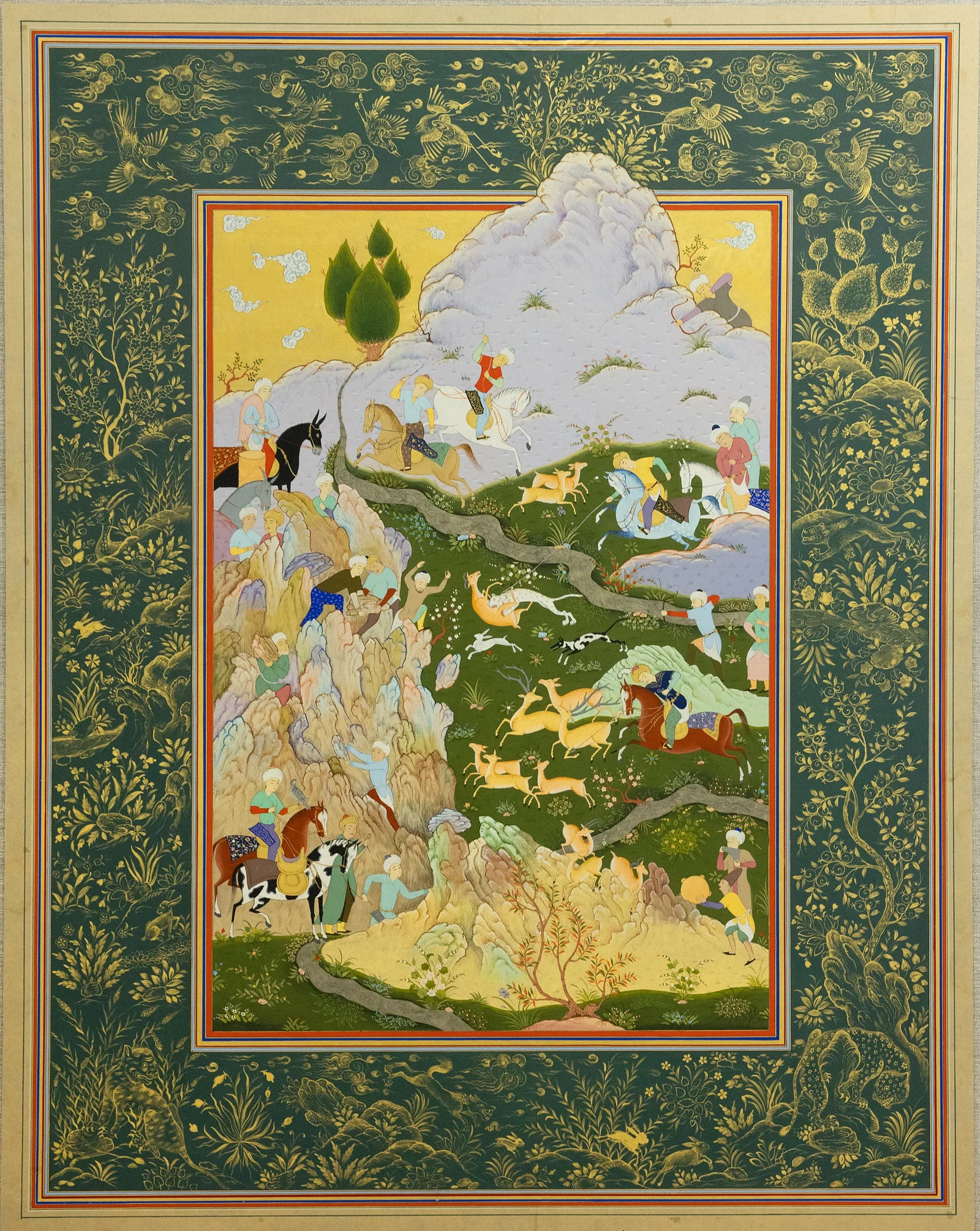
Image size:69 × 89 cm
The green field seethes with movement: horsemen on white, bay and grey horses drive on gazelles and does, the greyhounds are already overtaking their quarry, and above, an archer stretched flat along the slope takes aim downward. From the direction of the fantastical layered crags the beaters come noisily on foot — driving the game out of its hiding places straight into the arrows. Below on the left a party is making ready, a hunting bird upon the hand; at the right edge a man raises a long pipe to his lips — its voice is woven into the common chase, for on such battues the game was also roused by sound. But the heart of the scene is at its centre, and it is quieter than all this fury. The horseman on the bay does not strike the gazelle with an arrow, nor pierce it with a spear: in his hand is a taut lasso, whose loop has caught the beast by the leg. He takes it alive. And here the hidden depth of this hunt is revealed. The swift gazelle, in the Sufi reading, is an image of the hal — that fleeting illumination which descends for a moment and cannot be grasped. It is pursued with all the strength of the spirit, yet to pierce it with an arrow would be to destroy it: truth cannot be seized by force. It can only be gently caught, held alive, unharmed — and so the lasso about the leg is surer than the arrow. The whole scene is about that utmost concentration with which the seeker strives to catch the elusive without killing it. That is why the figure who keeps apart from the chase, upon a dark mule, is full of meaning: while all pursue the visible quarry, someone has already overtaken the unseen. This work took eleven months. About the work The scene of the battue is one of the root subjects of Persian-Turkic miniature, in which courtly valour and the splendour of the royal outing always admitted a second, allegorical reading. The work continues the tradition of the Bukhara school of the sixteenth and seventeenth centuries, with its inheritance from the Herat circle: the many-figured composition unfolds vertically, the 'layered' crags and the golden sky build a conventional, timeless space, and the dense golden border is peopled with beasts and birds. The image of the pursuit of the gazelle as the catching of an elusive illumination is close to the spirit of the mystical poetry of Maverannahr, where the hunter and his swift-footed quarry become an allegory of the path toward an unattainable truth. The fineness of the brushwork — the figures, horses and grasses drawn with a brush almost to a hair's breadth — answers to the courtly taste of the age. Details Base: Natural handmade Bukhara silk paper (90% silk, 10% cotton) Technique: Tempera, watercolour, natural plant and mineral pigments, gold leaf (23 carat) Unique piece


Similar products

Thank you
Your request has been sent, our staff will contact us shortly