

The Conversation of the Sage and the Gardener
Home / Miniatures / The Conversation of the Sage and the Gardener




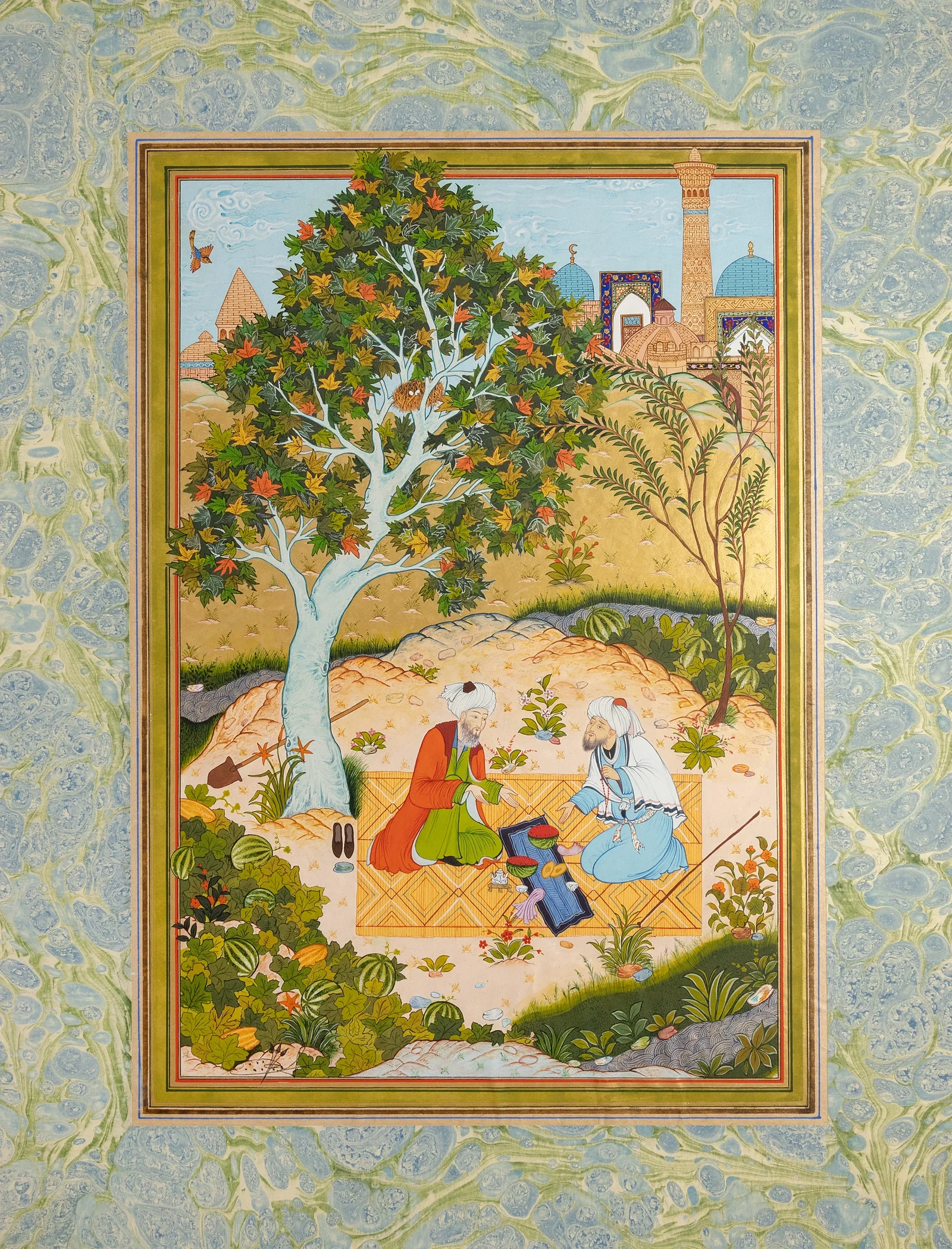
Image size:36 × 47 cm
The Conversation of the Sage and the Gardener Two men sit on a yellow woven mat with a rhomboid pattern, face to face, and between them is not a dispute but a repast: on a dark rectangular dais lie slices of watermelon and melon, and a small vessel for drinking stands there. The gardener, in an orange robe over a green one, extends his hands toward the fruit — the gesture not of one who speaks but of one who offers. The scholar in blue had been telling his prayer beads, but his fingers have gone still: the names of God, spoken aloud, yield to that which is offered in silence. Thus is resolved the ancient question — whose knowledge is truer. One sought the truth by books and beads; in the tradition even a strict ascetic would not eat this fruit, finding no written justification for it. The other simply grew it and now holds it out. The watermelon here is a fruit of the Sunna and a sign of the abundance granted from above: its core, filled with a multitude of seeds, speaks of a bounty that is not proven but received with gratitude. Beside the gardener lie a spade and cast-off shoes, as of one who has stepped onto pure ground. Above them a plane tree holds green, gold, and crimson foliage all at once — all the seasons of life in a single crown; in its branches a nest is hidden, and higher still a bird passes in flight. Beyond the golden hills rise turquoise domes and a minaret — the built world of learning, from which the two have gone out into the garden to read the signs without an intermediary. This scene took half a year of painting with a single-hair brush. About the work The work continues the tradition of Bukhara book miniature of the 16th–17th centuries — the art of Maverannahr, where the heritage of the Herat circle grew together with the local taste for a dense, lived-in garden. The conversation in a garden (suhbat) is an enduring subject of the Persian–Central Asian tradition: a shared meal beneath a tree becomes an image of spiritual colloquy. The motif in which the living wisdom of a labourer is set above bookish learning is close to the parable poetry of the region — from Jami to Navoi. The fine rendering of foliage, the continuous gilded background, and the turquoise of the domes are marks of this circle. The architectural background with domes and a minaret conveys the appearance of Bukhara and Samarkand without reproducing any particular building. Details Base: Natural handmade Bukhara silk paper (90% silk, 10% cotton) Technique: Tempera, watercolour, natural plant and mineral pigments, gold leaf (23 carat) Unique piece


Similar products

Thank you
Your request has been sent, our staff will contact us shortly