

The Dervish's Dance
Home / Miniatures / The Dervish's Dance




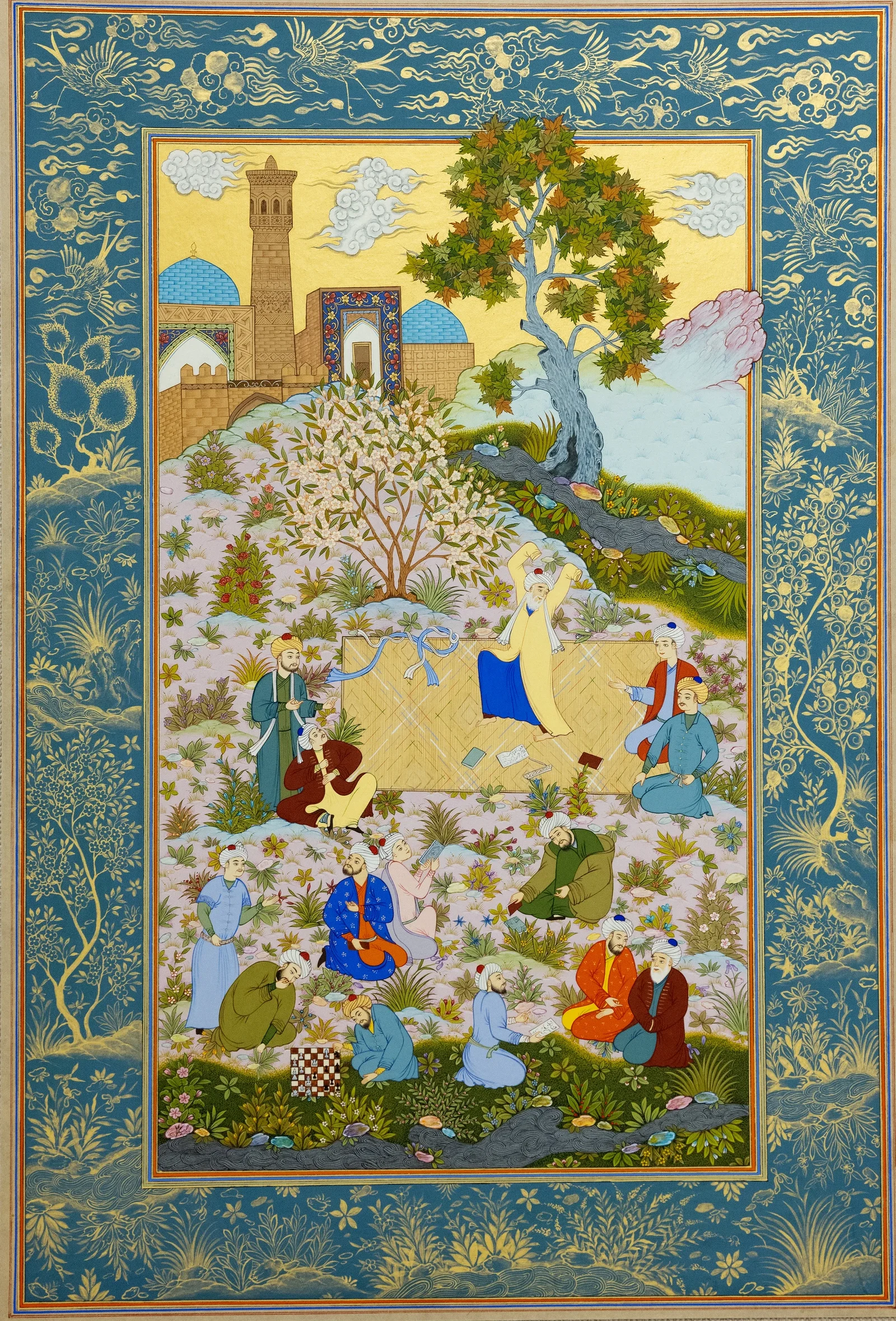
Image size:40 × 60 cm
In a garden, on a gentle slope facing the viewer, a company has gathered, and each is occupied with his own thing. Two are bent over a chequered board, absorbed in the game; another peers into a sheet of paper; two grey-bearded elders are engaged in quiet conversation; the one seated in green examines some note, without letting go of his own notebook, and opposite him a man in pale pink holds an open book. The letter, the rule, the argument, the move of a piece — the way of the mind that goes toward the Truth through reasoning. And in their midst one has risen and begun to whirl. His robe unfolds in broad folds, his arms are open, his body given over to the spinning without remainder. Around him, scattered over the ground, lie sheets of paper — as though words, having done their work, have been set free. This is the one who has passed from reading about the Path to the Path itself: from knowledge to the taste of knowledge, which cannot be held on paper. Behind, a tree in white blossom stands beside another whose foliage is already touched by autumn: in this garden spring and autumn are neighbours, and time loses its sharpness. Farther off rise the turquoise domes and the tower of the city, and across the gold of the sky pass birds — a long-standing image of souls in flight. A brush the thickness of a single hair spent four months on this work. The sama here is not a performance but a dissolution: those seated remain witnesses, while the one who whirls, for a single breath, erases the boundary between himself and the Truth. About the work The sheet continues the tradition of the Bukhara miniature of the 16th–17th centuries — the court school of Maverannahr, which absorbed the heritage of Herat and joined it with the local taste for the dense patterned garden and the golden sky. The motif of the garden gathering, where scholarly pursuits, games and conversation are neighbours to spiritual rapture, is one of the enduring subjects of Persian–Central Asian book painting. Whirling and the sama as a form of devotional practice belong to the practice of a number of Sufi brotherhoods; and yet Bukhara itself is the homeland of the Naqshbandi path, for which a quiet, hidden remembrance is more characteristic. The fine working of foliage, fabrics and tiled architecture, the abundant gold, the high horizon line and the decorative border with birds are the characteristic marks of the school. The image is conceived in the spirit of a manuscript illustration, yet exists as an independent sheet. Details Base: Natural handmade Bukhara silk paper (90% silk, 10% cotton) Technique: Tempera, watercolour, natural plant and mineral pigments, gold leaf (23 carat) Unique piece


Similar products

Thank you
Your request has been sent, our staff will contact us shortly