

SHAMS. (Jamal)
Home / Miniatures / SHAMS. (Jamal)




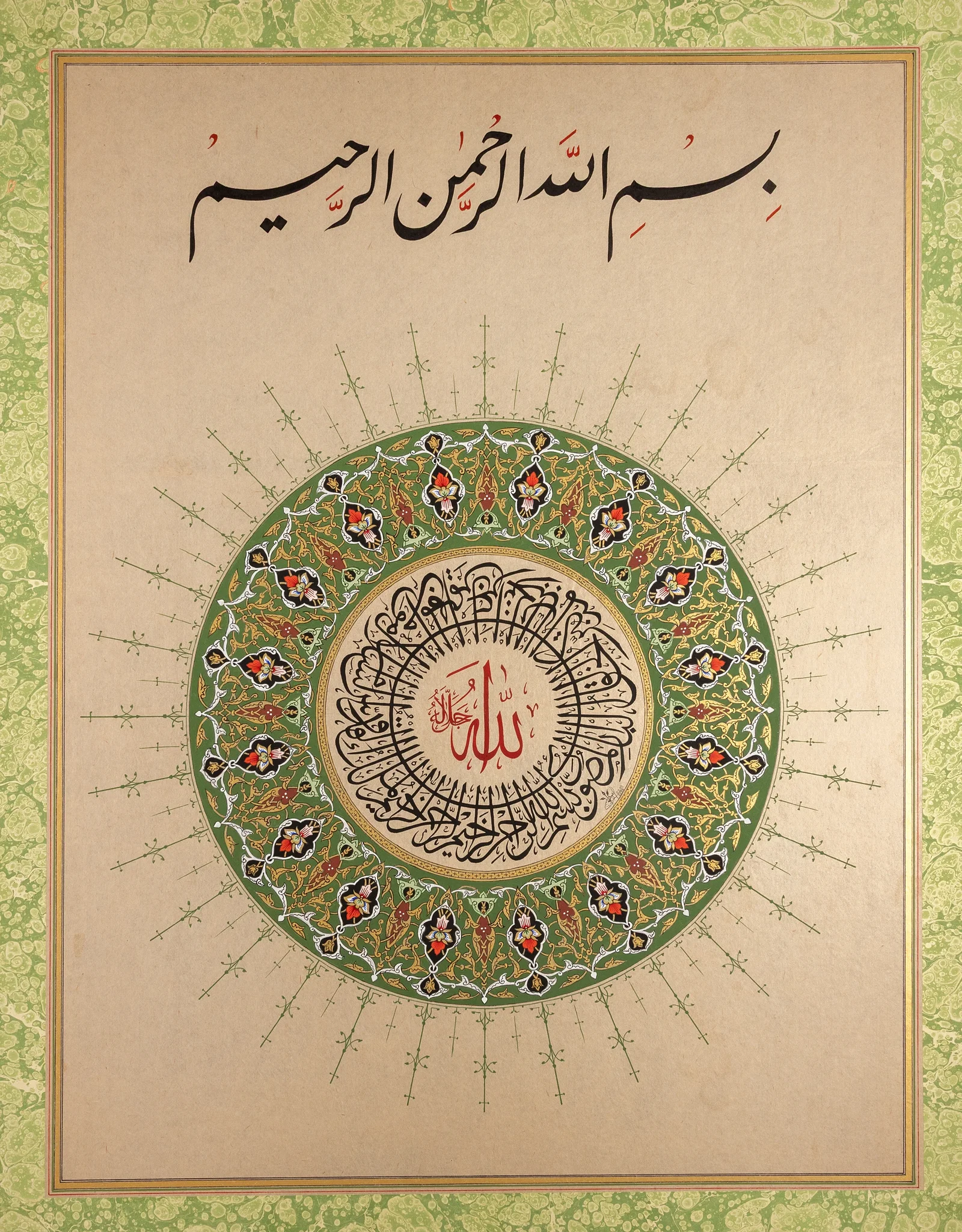
Image size:45 × 57 cm
The sheet begins at a threshold: above is traced the Basmala — 'In the name of Allah, the Most Gracious, the Most Merciful', the words with which every good work is opened. Below unfolds the shamsa, the 'sun': a round rosette from which the finest green-and-gold rays spread in every direction. At its very core the Name is inscribed in red — الله — and beside it, in gold, His glorification. Around the Name winds a ring of calligraphy, the testimony of the oneness of God, coiled into an unbroken spiral: here the word has neither beginning nor end — like the One to whom it bears witness. The whole geometry of the sheet is subject to a single movement: light issues from the centre, where the Name is, and to it returns. The rays pierce nothing and struggle against nothing — they pour forth, and each points back toward the centre. The green field with its golden interlace is the colour of the gardens of paradise and of their promised coolness, mercy and peace. The interlace itself, the islimi, winds on in shoots and buds without end or edge — an image of an inexhaustible creation that has no limit. The renunciation of every likeness here is not poverty but precision: the Inconceivable cannot be depicted — it can only be pointed to. Fifteen months went into this sheet, painted with a hair-fine brush — a labour in which its very duration becomes a form of standing before God. About the work The shamsa ('sun') is one of the supreme forms of Islamic book art: a round illuminated rosette with which manuscripts of the Quran and sumptuous compendia were opened, placing at its heart the name of God or a dedication. This is not illustration but calligraphy and ornament in their pure form — that branch of the tradition in which the image yields its place to the Word and to geometry. The sheet is executed by the master Davlat Toshev, whose art is closely bound to the Sufi tradition; the composition follows the canon — the sacred text in the centre, concentric rings of plant interlace (islimi), and diverging rays that turn the sheet into the image of a luminary. In the court workshops of Maverannahr and, more widely, throughout the Perso-Islamic world, such rosettes were executed with the finest brush and demanded many months of work. The combination of green, gold and red cinnabar, the 'marbled' ebru border and the hair-fine working of the ornament are characteristic of the high book culture of this circle. Details Base: Natural handmade Bukhara silk paper (90% silk, 10% cotton) Technique: Tempera, watercolour, natural plant and mineral pigments, gold leaf (23 carat) Unique piece


Similar products

Thank you
Your request has been sent, our staff will contact us shortly