

The Royal Hunt
Home / Miniatures / The Royal Hunt




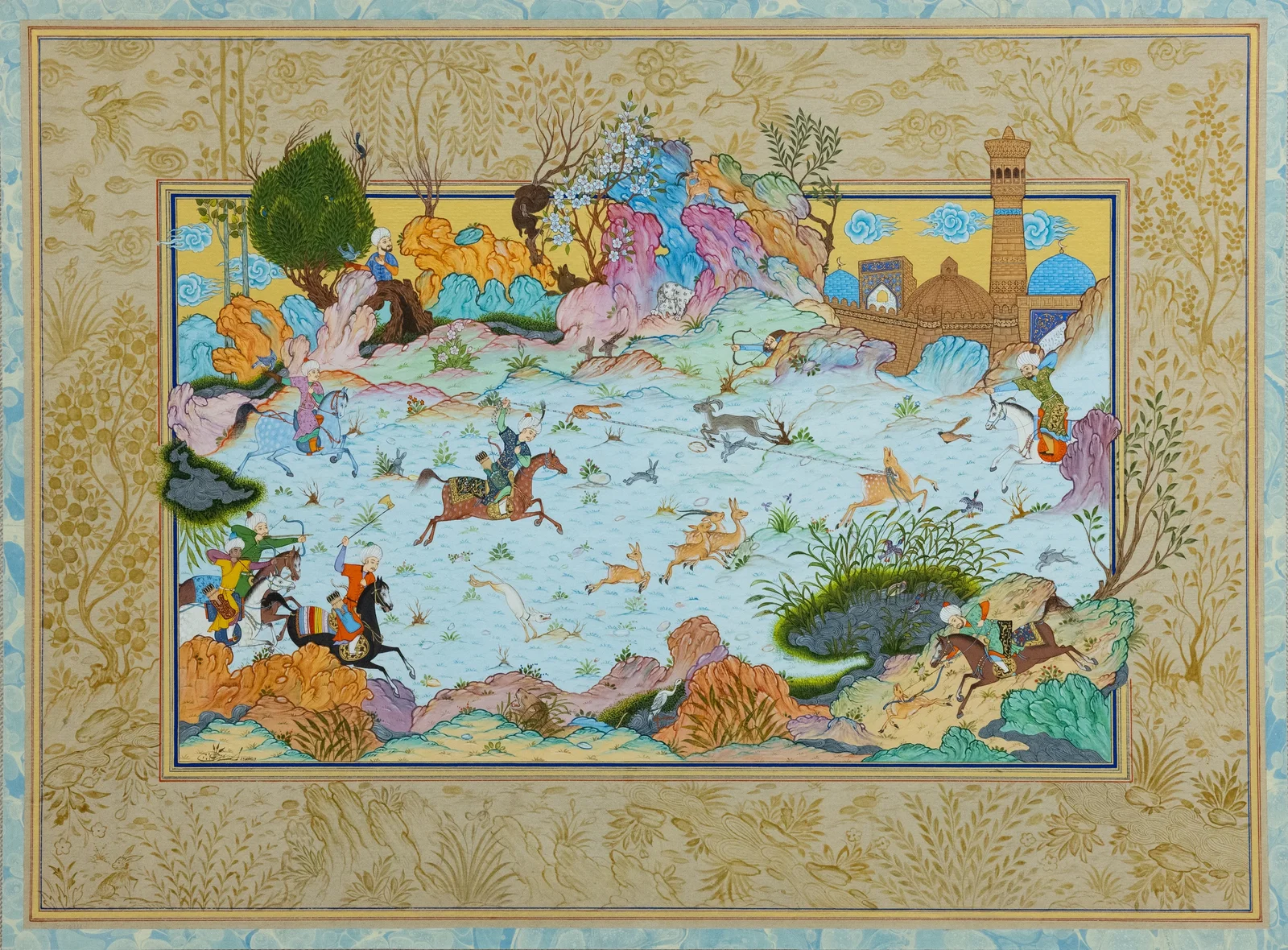
Image size:55 × 40,3 cm
At the very heart of the chase lies a moment that reveals not strength but readiness: one rider on a bay horse, at full gallop, throws his lasso over the horns of a fleeing doe, while another leans from his saddle and takes a gazelle by the neck with his bow, without loosing an arrow. All around are dozens of archers, their arrows still on the string or in the air, and dozens of beasts — gazelles, wild goats, hares, foxes — racing unharmed across a turquoise field. No blood, no miss, no hit: only the running. In the East the gazelle is an image of fleeting illumination, of that which is given not to force but to an instant of inner readiness; this is why, out of all this clamorous chase, only two manage to hold it alive, while the rest sweep past with weapons at the ready and empty hands. Off to one side, beneath a tree, a hermit sits motionless — one who attained his own illumination before the ride began, and therefore watches the storm of passions from without, taking no part in it at all. Behind them rises the recognizable silhouette of Bukhara — a slender minaret, the turquoise domes of a madrasa — amid coral cliffs shimmering with pink, lilac and turquoise. Six months went into this flash of movement, where the stillness of the contemplative and the fury of the chase balance one another like the two banks of a single river. About the work The royal hunt (shikor) is one of the principal subjects of the court art of Maverannahr and of the whole Persian world: it was not an amusement but a ritual of state, a demonstration of the ruler's power over the land and its creatures. Davlat Toshev builds the scene along a diagonal, from the quiet figure of the hermit in the upper corner to the whirl of riders below, creating the sense of a single sweep across the canvas. The mountains are painted in the manner of 'coral cliffs' — a device characteristic of the masters of the sixteenth and seventeenth centuries, who loved to turn landscape into a shimmering, half-fabulous space. The architectural silhouette in the far distance echoes the appearance of Bukhara, giving the scene a recognizably Central Asian character. The hashiya, with its peacefully grazing does and singing birds, deliberately balances the storm on the sheet itself — a device often used by the masters to create an inner contrast between the border and the centre. Details Base: Natural handmade Bukhara silk paper (90% silk, 10% cotton) Technique: Tempera, watercolour, natural plant and mineral pigments, gold leaf (23 carat) Unique piece


Similar products

Thank you
Your request has been sent, our staff will contact us shortly