

Khosrow and Shirin
Home / Miniatures / Khosrow and Shirin




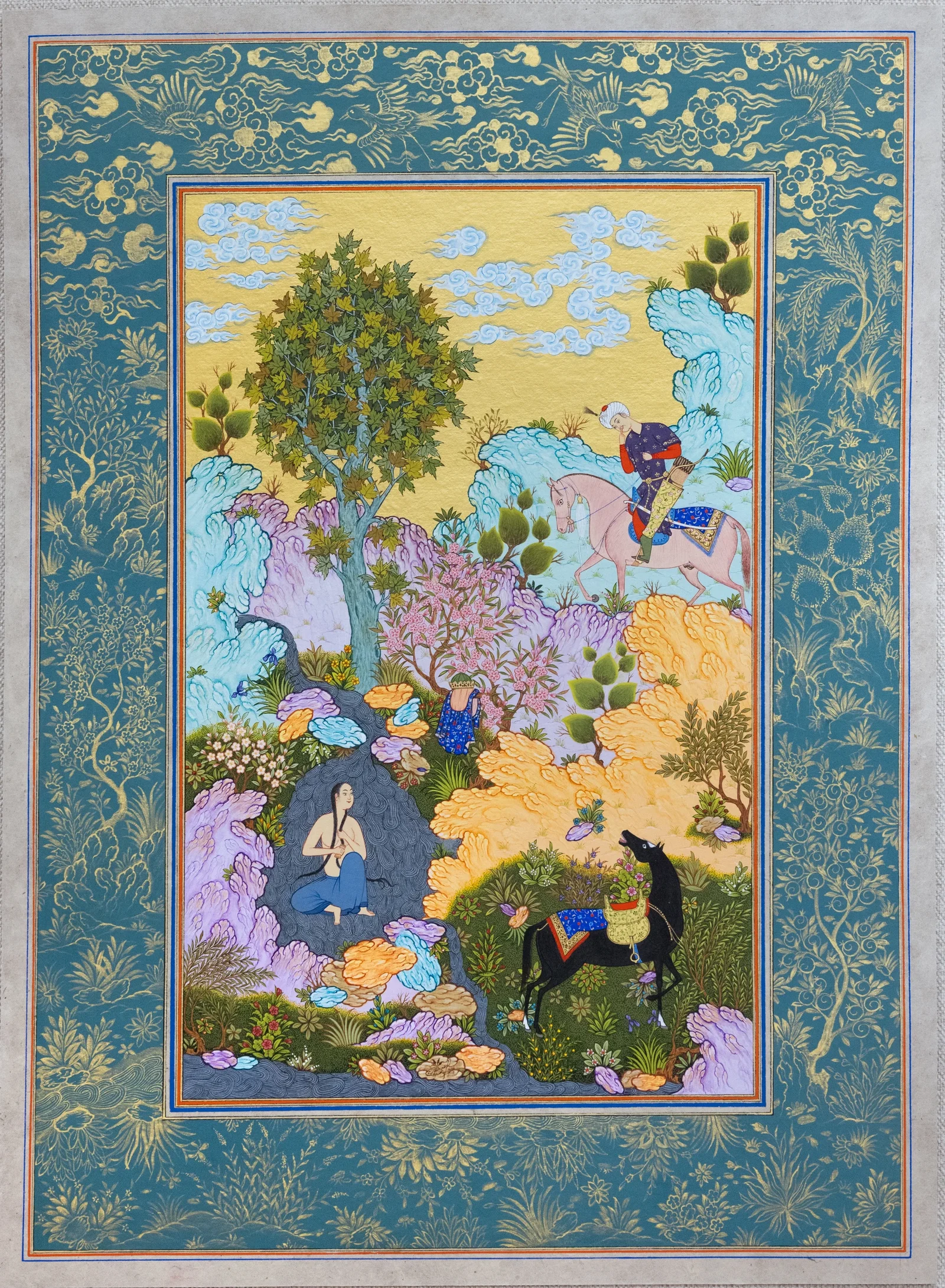
Image size:40,5 × 55 cm
At the foot of the crags, there where a spring flows down among many-coloured stones, sits a girl with her black hair let loose — the water covers her as tenderly as the very stones of the grotto, leaving only what is permitted to be seen. Above, on a pink horse, a rider in blue raiment has frozen still: he has raised a finger to his lips — a gesture of mute rapture, with which in the East one answers not with words but with silence, when a word would be too coarse for what has been seen. He was not seeking this encounter — he was merely riding past, and the road itself turned into destiny. Thus is built the opening of many Persian poems about lovers: the hero finds his betrothed not by arrangement but by the water, as though the elements themselves set up meetings before people manage to desire them. The spring here is not merely landscape but a threshold: what is hidden beneath its surface will be revealed later, while for now the cool water serves as a veil of chastity, behind which beauty is only guessed at. Below, some way off, stands a black horse without a rider — a patient companion that waits without stirring from its place, the embodiment of a fidelity that has no need of haste. The coral and lilac crags, the golden sky and the flowering branches all around turn the chance encounter into a place seemingly borne beyond ordinary time — not earth, but its transfigured image. This scene took seven months of labour with the finest brush. About the work The miniature goes back to one of the most recognizable subjects of the Persian–Central Asian literary tradition — the story of Khosrow and Shirin, sung by Nizami and later reinterpreted more than once, including by Navoi and Amir Khosrow Dehlavi. The scene of the chance recognition by the spring is an enduring and beloved episode of this cycle in the book painting of the region. The fantastical, many-coloured crags and the golden background are characteristic of the court miniature of Maverannahr of the 16th–17th centuries, where the landscape serves not as a background but as a participant in the narration. The chaste, indirect presentation of the nude figure is a typical device of this school, which avoids literalness for the sake of suggestion. The scene conveys not a specific textual episode word for word, but its established iconographic version. Details Base: Natural handmade Bukhara silk paper (90% silk, 10% cotton) Technique: Tempera, watercolour, natural plant and mineral pigments, gold leaf (23 carat) Unique piece


Similar products

Thank you
Your request has been sent, our staff will contact us shortly