

Celebration in the Garden
Home / Miniatures / Celebration in the Garden




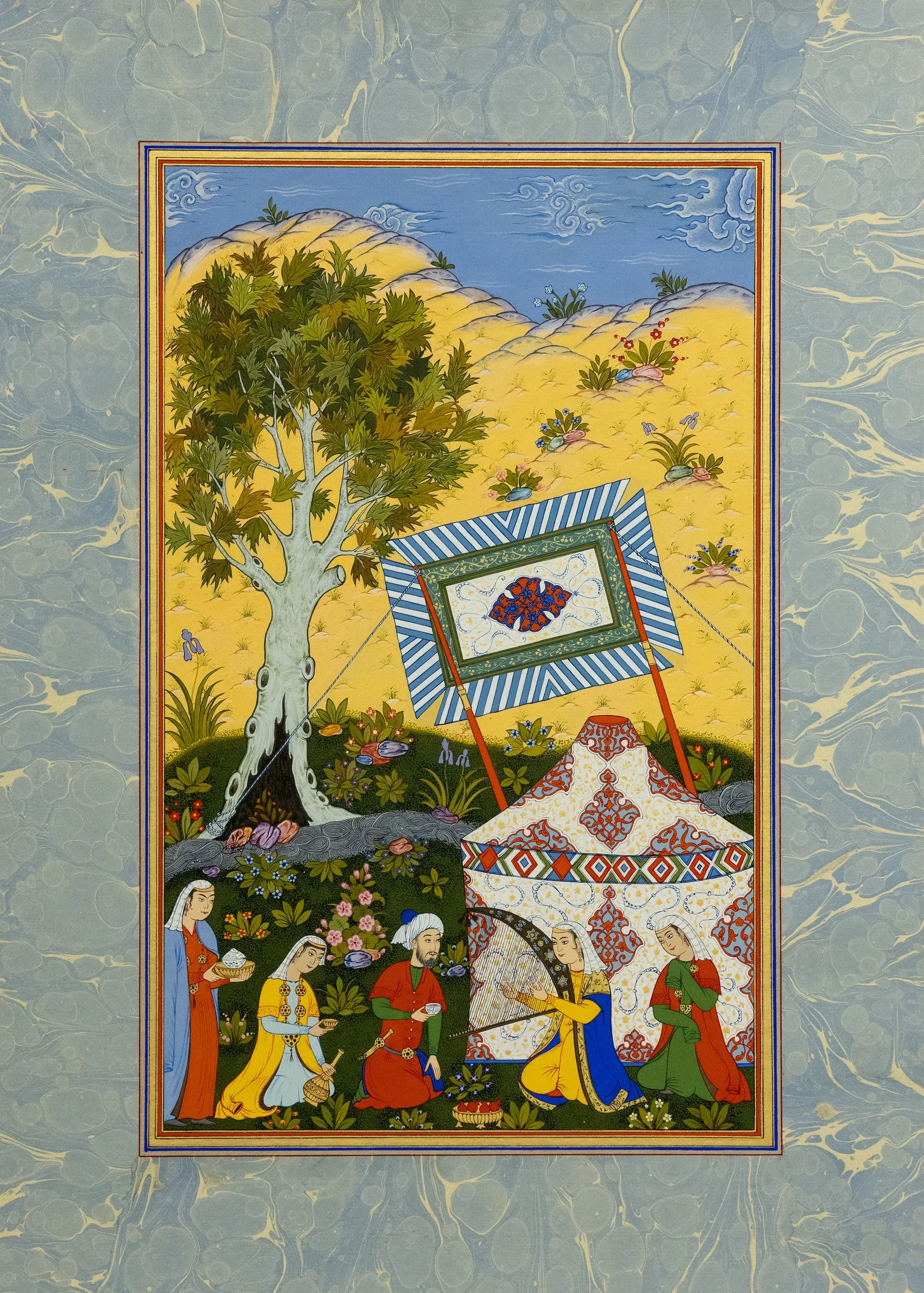
Image size:30,8 × 43,3 cm
Beneath an old plane tree, whose bark is speckled with the dark marks of the years, a group of five has settled — not a wedding, nor a farewell, but a moment of quiet celebration behind which something greater than a mere occasion for meeting can be sensed. One of the women offers a bowl of refreshments, another fills a cup with wine from a jug and holds it in readiness. A chang sounds, and this very sound already becomes part of the event: in the language of the Sufi ghazal, the cup of wine has long signified not intoxication but knowledge, and the way to it — the way to the Truth. But the host of the celebration looks neither at the proffered cup nor toward the music. His gaze — across the whole circle of guests — is directed to the woman at the entrance to the tent, whose hands are hidden in long sleeves: a gesture of reverence and inner concentration, long customary in this tradition. He is dressed in red with green armbands; she wears the same combination of colours. This is no accident of the cut, but a thread that has bound the two before the distance between them closes. At the feet of the woman musician lie four pomegranates: the Quran names this fruit among the gifts of paradise (Surah Ar-Rahman, 55:68), and in the Islamic tradition it has long served as an image of the Divine presence — not of paradise as a place, but of paradise as a state of nearness to the Creator. The host's gaze points to where this nearness now dwells: not in the cup, nor in the music, but in her herself. Half a year went into this scene — with a fine brush, grain by grain, light by light. About the work The miniature belongs to the tradition of the Bukhara school of the 16th–17th centuries, where the scene of the garden feast was not a genre subject but an enduring poetic topos that absorbed the language of the Sufi ghazal: wine, music and hospitality were read by contemporaries not only literally. Such compositions were created at the courts of Maverannahr, where book miniature developed in close connection with the poetry of Navoi, Hafiz, Jami and with the Naqshbandi tradition, which set the inner solitude of the heart amid worldly life above outward asceticism. The characters are not identified as specific historical persons — the subject remains open, lending the scene a timeless, parabolic character. Details Base: Natural handmade Bukhara silk paper (90% silk, 10% cotton) Technique: Tempera, watercolour, natural plant and mineral pigments, gold leaf (23 carat) Unique piece


Similar products

Thank you
Your request has been sent, our staff will contact us shortly