

In the Presence of Amir Temur
Home / Miniatures / In the Presence of Amir Temur




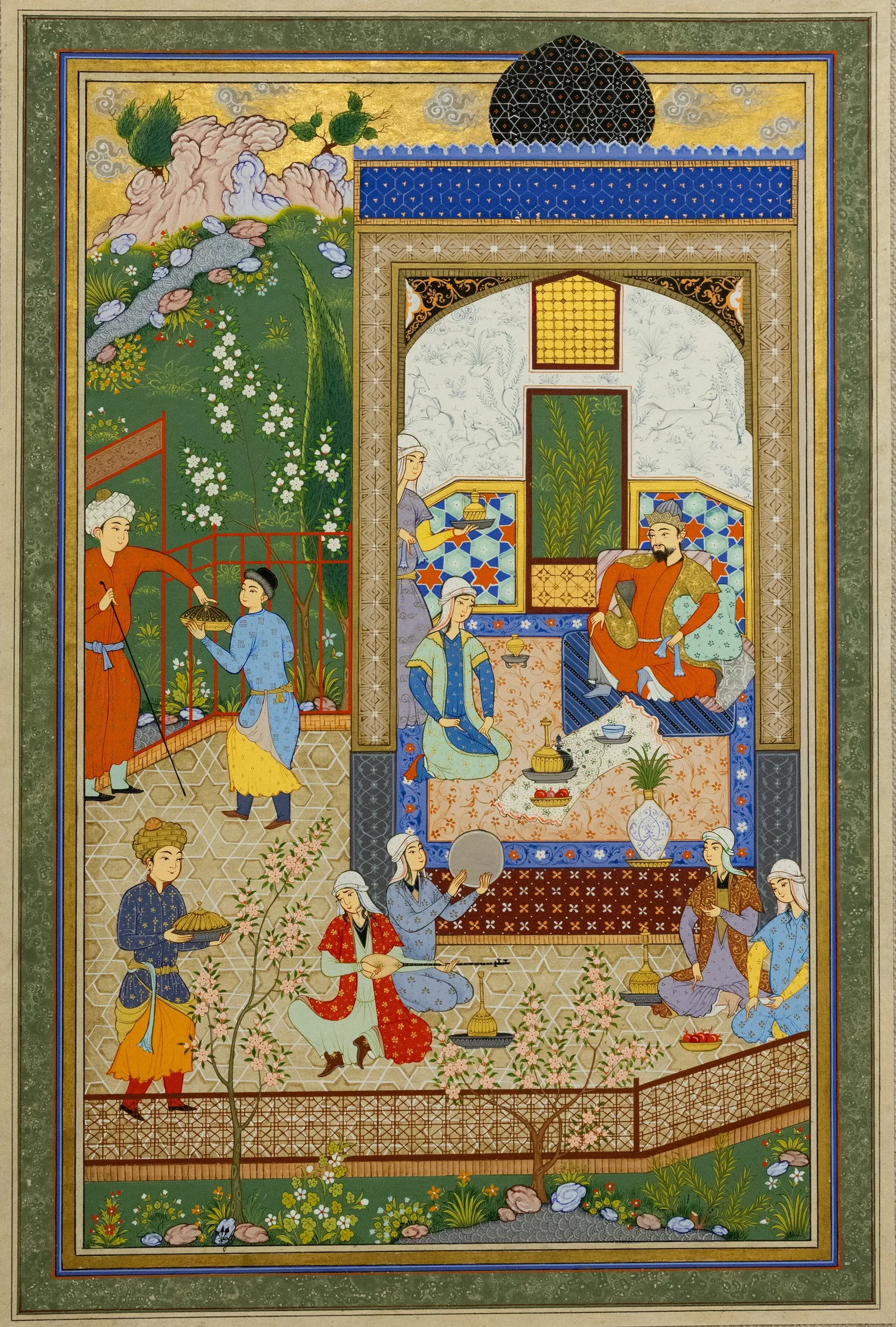
Image size:31 × 47,5 cm
On the left is a garden: a white flowering shrub, a brook among the stones, two servants with covered dishes passing the fare from one to another — the movement begins at the very edge of the frame, before it reaches the principal figure. Below, in the shade of a small blossoming tree, are women musicians: one holds a tanbur, another a doira raised for the beat; nearby are handmaids with a bowl of pomegranates and a pitcher. The pomegranate here is not merely a fruit of the garden: beneath its dense, sealed rind hide seed pressed to seed, close and unseen until it is broken open — just as, in the palace, outward deference conceals what is truly taking place within each of those present. The music and the offerings rise from below upward, as if the earth itself were preparing a gift for the one enthroned above. And above, in a carved niche behind a star-patterned tiled wall, is Amir Temur. He wears an orange robe over a golden patterned caftan, leaning upon a cushion with that calm heaviness which is given not by force but by right. Before him are a golden vessel, a blue bowl, pomegranates on a white cloth: not a feast, but an order built around a single presence. A woman on the left offers a dish, another sits at his very feet — the approach to the centre proceeds gradually, in circles, as in the garden itself. Above the niche the wall is painted with a fine pen: a doe, a hare, a running beast amid the grasses — a world hushed in reverence before it enters the golden sky. The master gave this crowded scene six months of labour — exactly enough for each of the dozens of faces to receive its own, separate breath. About the work The miniature belongs to the tradition of the courtly audience — an enduring subject of the Timurid-Bukhara school, in which the ruler is depicted within an architectural framing, while the garden before him unfolds as a continuation of the palace hierarchy: the nearer to the sovereign, the stricter the order of the figures. The many-figured composition, with its women musicians, servants and courtiers, goes back to the Herat tradition of book miniature and was especially persistent in depictions of scenes from the life of Amir Temur, who became a symbolic figure for the artists of Maverannahr in the sixteenth and seventeenth centuries. The combination of a genre scene in a garden with a ceremonial audience in the palace is a characteristic device for conveying the many-layered nature of courtly life. Details Base: Natural handmade Bukhara silk paper (90% silk, 10% cotton) Technique: Tempera, watercolour, natural plant and mineral pigments, gold leaf (23 carat) Unique piece


Similar products

Thank you
Your request has been sent, our staff will contact us shortly